

Leibish Fried & Associates built a strong reputation for handling everything from simple bookkeeping to complex year-end adjustments. But behind their client-facing success was the same operational chaos that plagues most growing accounting and bookkeeping companies – disconnected systems, scattered information, and no clear path to scaling without proportionally increasing headcount.
What the Client Says
“Imrul and his team at Camel Tech are a blessing. It’s a true pleasure working with them. They deserve the highest ratings in quality, speed, service and communication!”
Leibish Fried, Founder, Leibish Fried & Associates
The 7 Problems That Create Chaos in Accounting and Bookkeeping Firms
These are the exact operational bottlenecks that were holding Leibish Fried & Associates back – and they’re the same problems most accounting and bookkeeping companies face when trying to scale.
1. Inaccurate Time Tracking
The team had no visibility into actual hours spent per client. They tried Timely app for automatic tracking, but it wouldn’t integrate properly with their ClickUp workspace structure. Without accurate time data, they couldn’t determine which clients were profitable or identify where time was being wasted. This is one of the most common reasons accounting firms struggle to scale – you can’t optimize what you can’t measure.
2. Scattered Client Information
Critical details lived everywhere – accountant preferences in emails, payroll rules in spreadsheets, client-specific instructions in people’s heads. When an employee needed information, they had to dig through multiple sources or ask colleagues directly. This kind of information chaos makes it nearly impossible to streamline your accounting and bookkeeping company because every task starts with a scavenger hunt.
3. Disorganized ClickUp Workspace
The firm’s ClickUp workspace had grown chaotically over time. Client folders mixed with internal projects. Tasks for 137 entities created thousands of items with no clear hierarchy. Custom fields appeared everywhere, even when irrelevant to specific views. This is what happens when you implement ClickUp for your accounting firm without a clear architecture plan – the tool becomes part of the chaos instead of the solution.
4. No Workload Visibility
There was no data-driven way to answer basic capacity questions: Which team members were overloaded? Who had bandwidth for new work? Without workload visibility, Leibish couldn’t confidently scale the team or take on new clients. You can’t scale an accounting and bookkeeping company if you don’t know where your team’s time is going.
5. Unknown Client Profitability
Leibish Fried & Associates charged flat monthly fees but had no system to track actual costs per client. Some clients were likely subsidizing others, but nobody knew which ones. The lack of financial visibility made pricing decisions difficult and largely guesswork – ironic for a firm that helps other businesses manage their finances.
6. Manual Seasonal Adjustments
Some clients needed daily bookkeeping in summer but only monthly work in winter. Manually adjusting task frequencies for dozens of clients consumed hours each season, and mistakes were common. Automating these seasonal patterns is one of the highest-impact ways to streamline operations in any bookkeeping company.
7. No Process Documentation
Every employee handled tasks slightly differently. Training new hires meant weeks of shadowing because processes weren’t documented. If someone was out sick, their work sat idle because nobody else knew the client’s specific requirements. You cannot systemize your accounting and bookkeeping company without documented processes – it’s the foundation everything else is built on.
The bottom line: Leibish Fried & Associates could deliver quality accounting work, but growth felt impossible. The chaos of finding information, remembering processes, and fitting work into maxed-out schedules consumed the bandwidth they needed to scale.
How Camel Tech Removed the Chaos and Systemized the Entire Operation
Camel Tech partnered with Leibish Fried & Associates over several months to completely overhaul their operations using ClickUp.
Here’s exactly how we implemented ClickUp for this accounting and bookkeeping firm.
Solution 1: Four-Space Workspace Architecture
We restructured Leibish Fried & Associates’ entire ClickUp workspace around four core spaces:
- Client Fulfillment houses all client-facing work, organized by client folders with entity-level lists. Each list contains standardized task templates for bookkeeping, payroll, tax planning, and other services.
- HQ contains all internal operations including HR, IT, meetings, and team management.
- Growth manages the CRM, sales pipeline, lead tracking, and marketing efforts.
- SOPs & Templates serves as the centralized knowledge base with reusable templates and documented procedures.
This structure brought immediate clarity. Every task now has a clear home, and employees know exactly where to find what they need. For any accounting and bookkeeping company looking to remove the chaos, workspace architecture is where it starts.
Solution 2: Integrated CRM System
We built a comprehensive CRM with three interconnected directories – Client Info, Company Info, and Accountant Info. Using ClickUp’s relationship features, we created a single source of truth where updating information in one place automatically updates everywhere else.
When Leibish Fried & Associates adds a new client, they fill out the Client Info form and the system automatically creates the company record, links accountant relationships, and populates custom fields across all related tasks.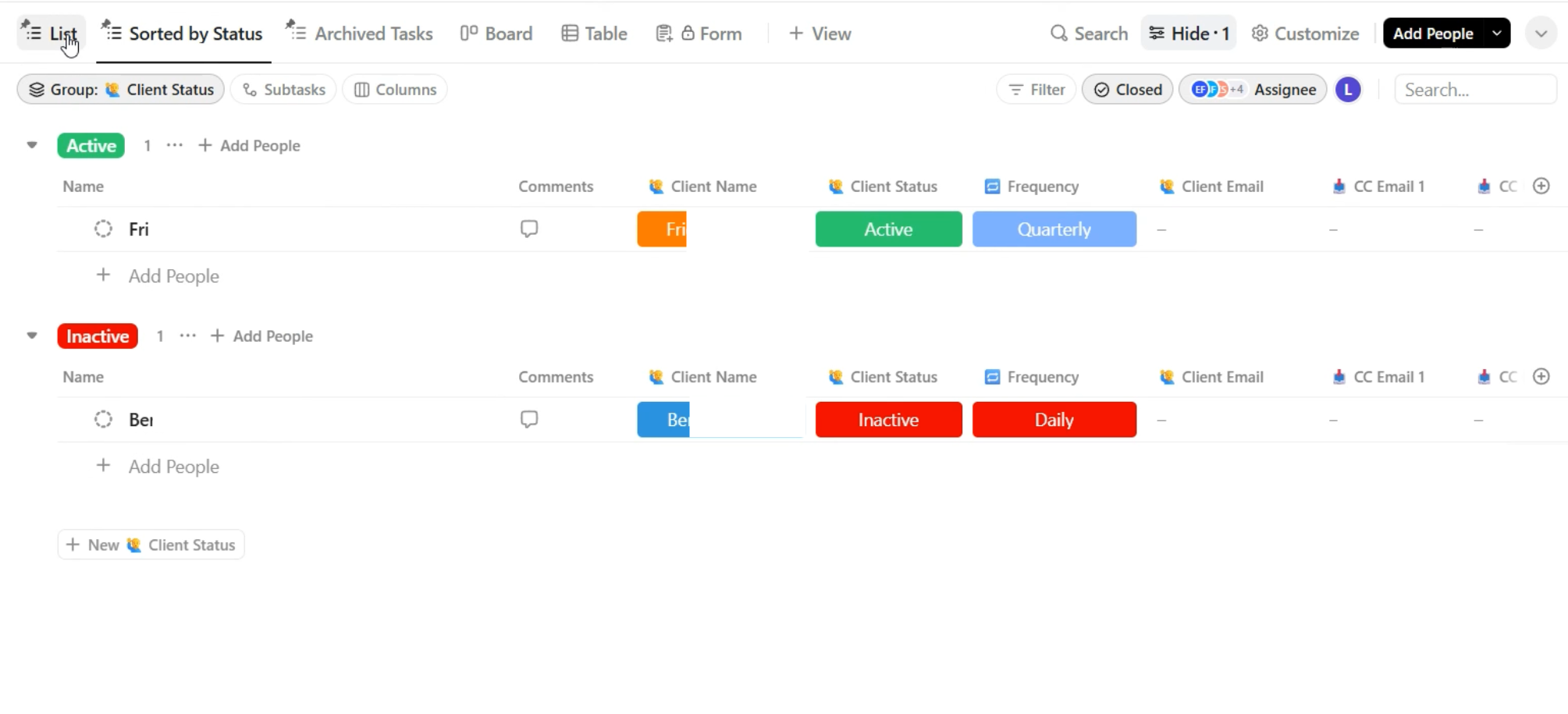
For year-end closing tasks, employees can now see the accountant’s contact details, preferred file format, and submission instructions – all pulled directly from the central profile. One update, everywhere it matters, automatically.
Solution 3: Master List Dashboard
We created a Master List that aggregates every task from every client folder into a single, filterable view. Leibish can now filter by client name, service type, assignee, status, or due date with one click.
Need to see all overdue bookkeeping tasks? One filter. Want to review everything assigned to a specific employee? Instant visibility. The Master List became the command center for the entire operation – and one of the most powerful ways to streamline how an accounting firm manages dozens of clients and hundreds of entities in ClickUp.
Solution 4: Automated Time Tracking Integration
We integrated TimelyApp with ClickUp by restructuring the workspace hierarchy to enable proper syncing. Time tracked across all applications – email, QuickBooks, and phone systems – now automatically tags to the appropriate client and task.
Employees review and categorize their tracked time at the end of each day. ClickUp’s timesheet feature consolidates everything into weekly dashboards showing exactly where hours are being spent. 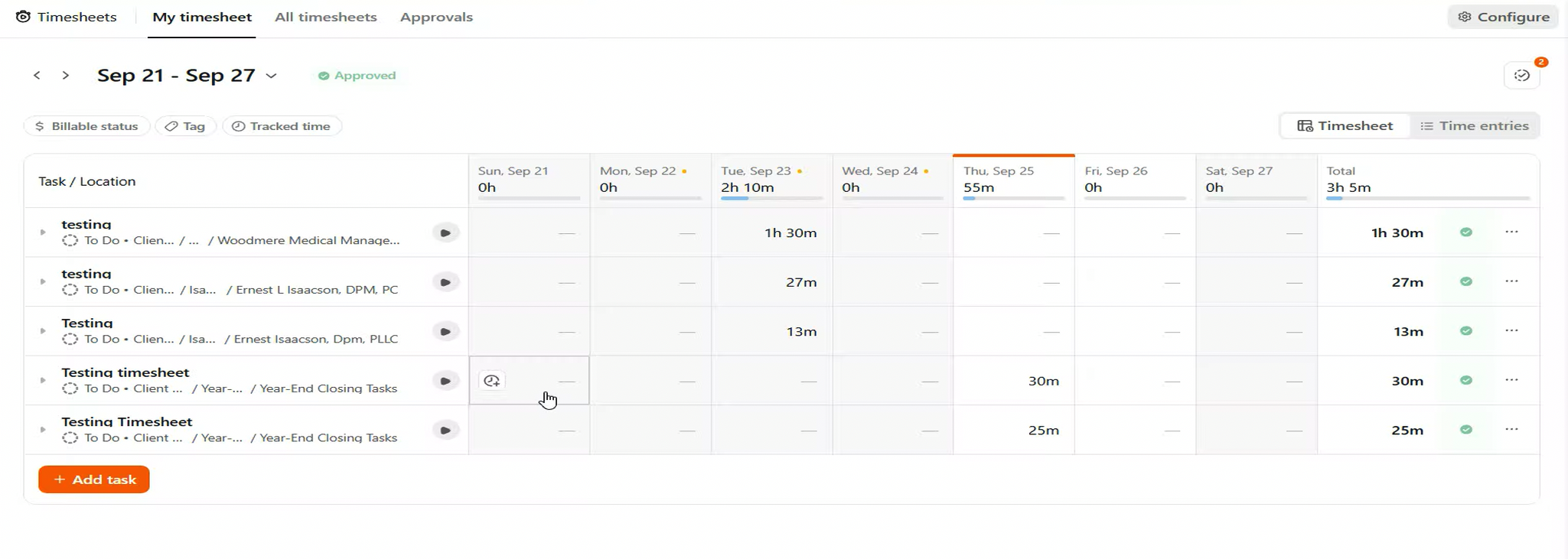 For bookkeeping and accounting firms trying to automate the busywork, time tracking is one of the highest-impact places to start.
For bookkeeping and accounting firms trying to automate the busywork, time tracking is one of the highest-impact places to start.Solution 5: Profitability Section with Dashboard
We built profit/loss tracking directly into the CRM. For each client, Leibish Fried & Associates inputs their monthly fee and estimated hours. The system calculates effective hourly rates, tracks actual time spent, and shows real-time profitability.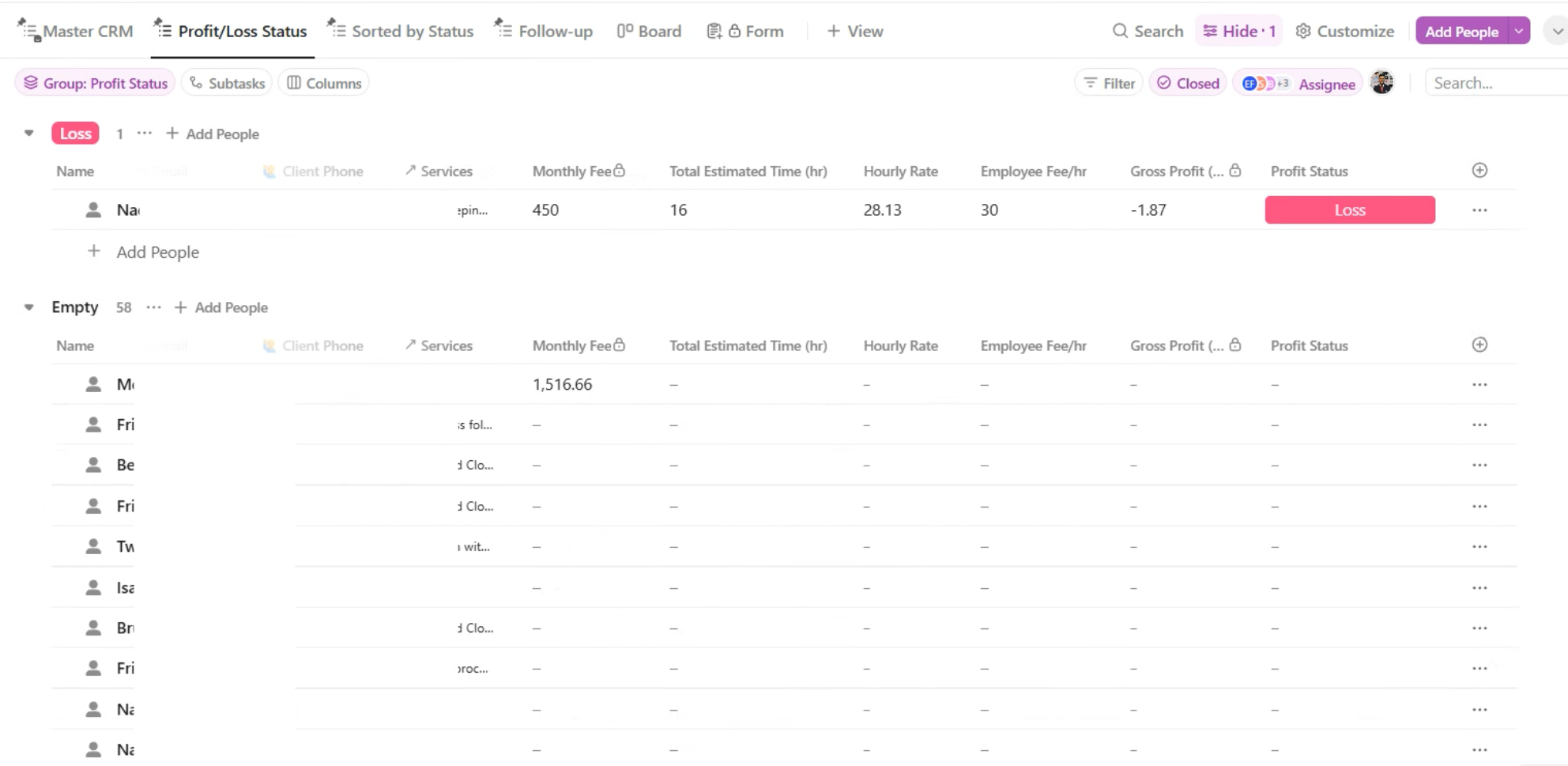
Dashboards visualize total monthly revenue, labor costs, gross profit by client, and flag loss-making accounts. This gave Leibish Fried & Associates the data they needed to make informed pricing decisions – and the kind of visibility every accounting firm needs before they can scale with confidence.
Solution 6: Seasonal Frequency Automation
We implemented smart task scheduling that automatically adjusts based on seasonal patterns. For each client, Leibish Fried & Associates specifies their seasonal work patterns using custom fields.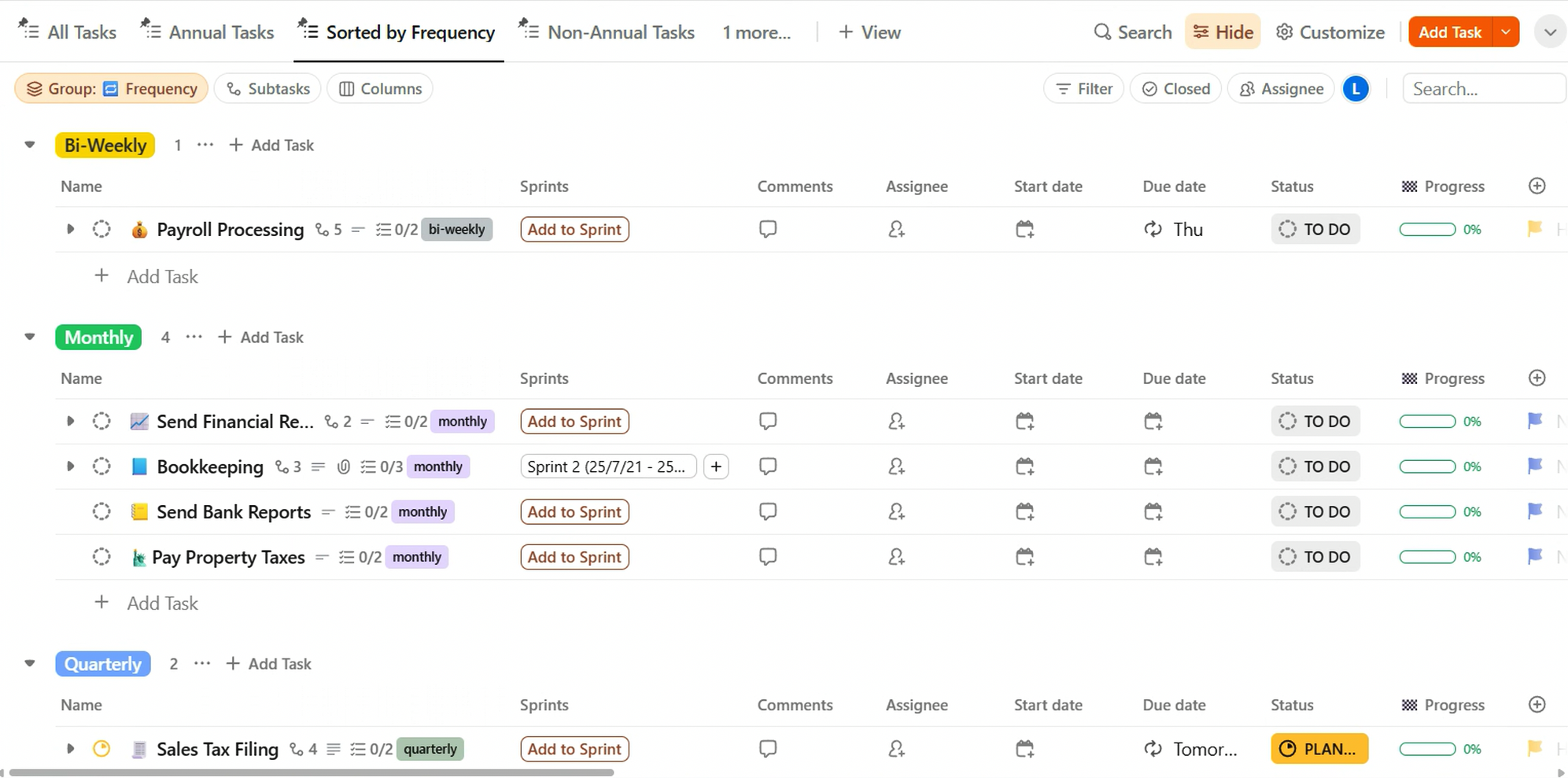 When seasons change, the system automatically updates task frequencies, adjusts tags, recalculates due dates, and modifies notifications without any manual work.
When seasons change, the system automatically updates task frequencies, adjusts tags, recalculates due dates, and modifies notifications without any manual work.Solution 7: Employee Dashboards
We created personalized dashboards for each team member showing today’s tasks with priority flags, overdue items, upcoming work for the next 7 days, time tracked vs. estimated by client, and workload capacity indicators. 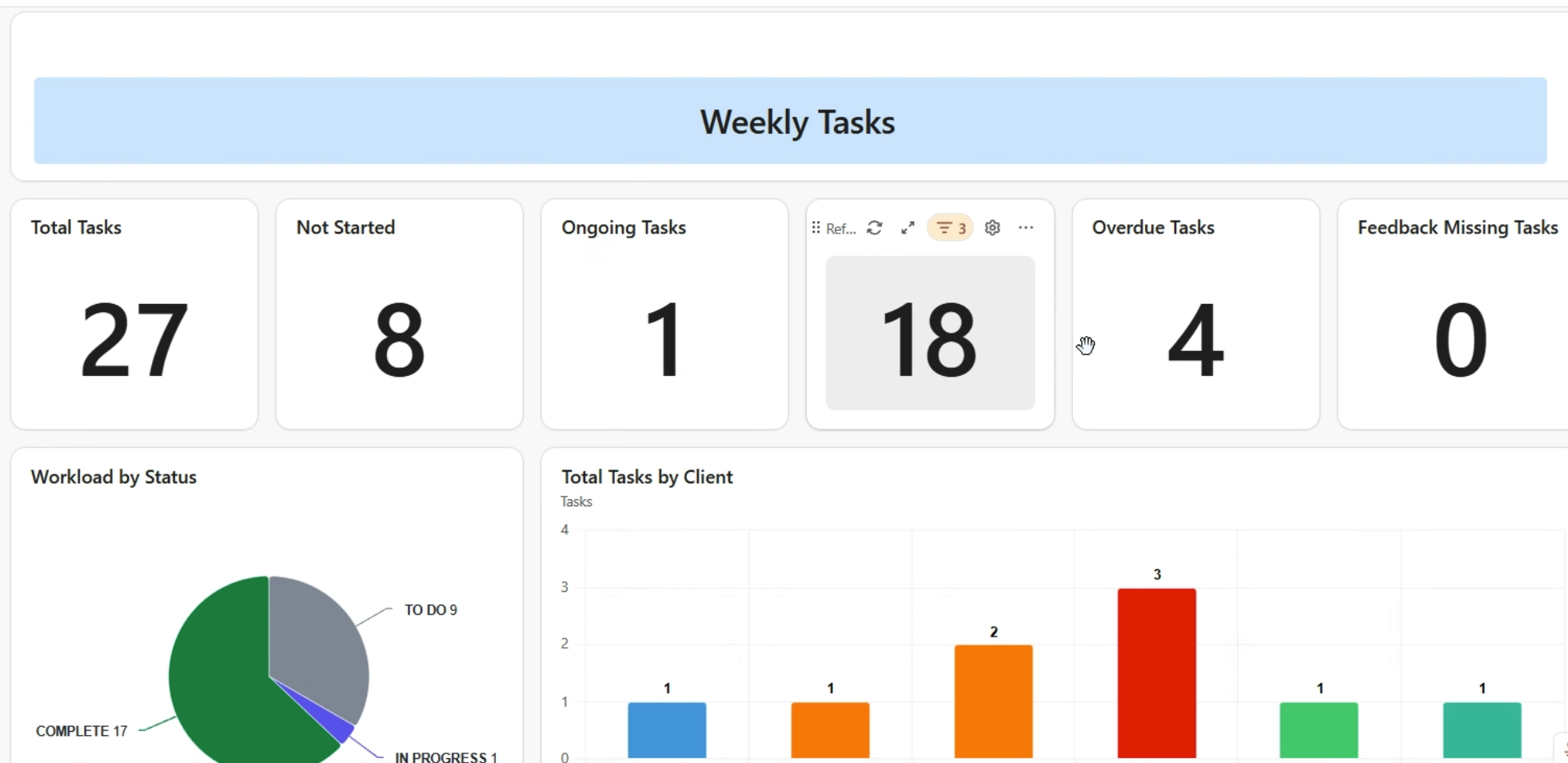 Each dashboard auto-filters to show only that employee’s assignments.
Each dashboard auto-filters to show only that employee’s assignments.Solution 8: Email Integration for Out-of-Scope Tracking
We integrated email directly with ClickUp so client emails automatically create tasks tagged as “Out of Scope.” Employees can respond from ClickUp, and all time spent is tracked. At month-end, Leibish Fried & Associates can review out-of-scope time per client and make billing decisions accordingly.
Solution 9: SOP Library
We created a centralized SOP space with documented procedures for every recurring process. Each SOP includes step-by-step instructions, video walkthroughs for complex processes, client-specific preferences, and links to relevant templates.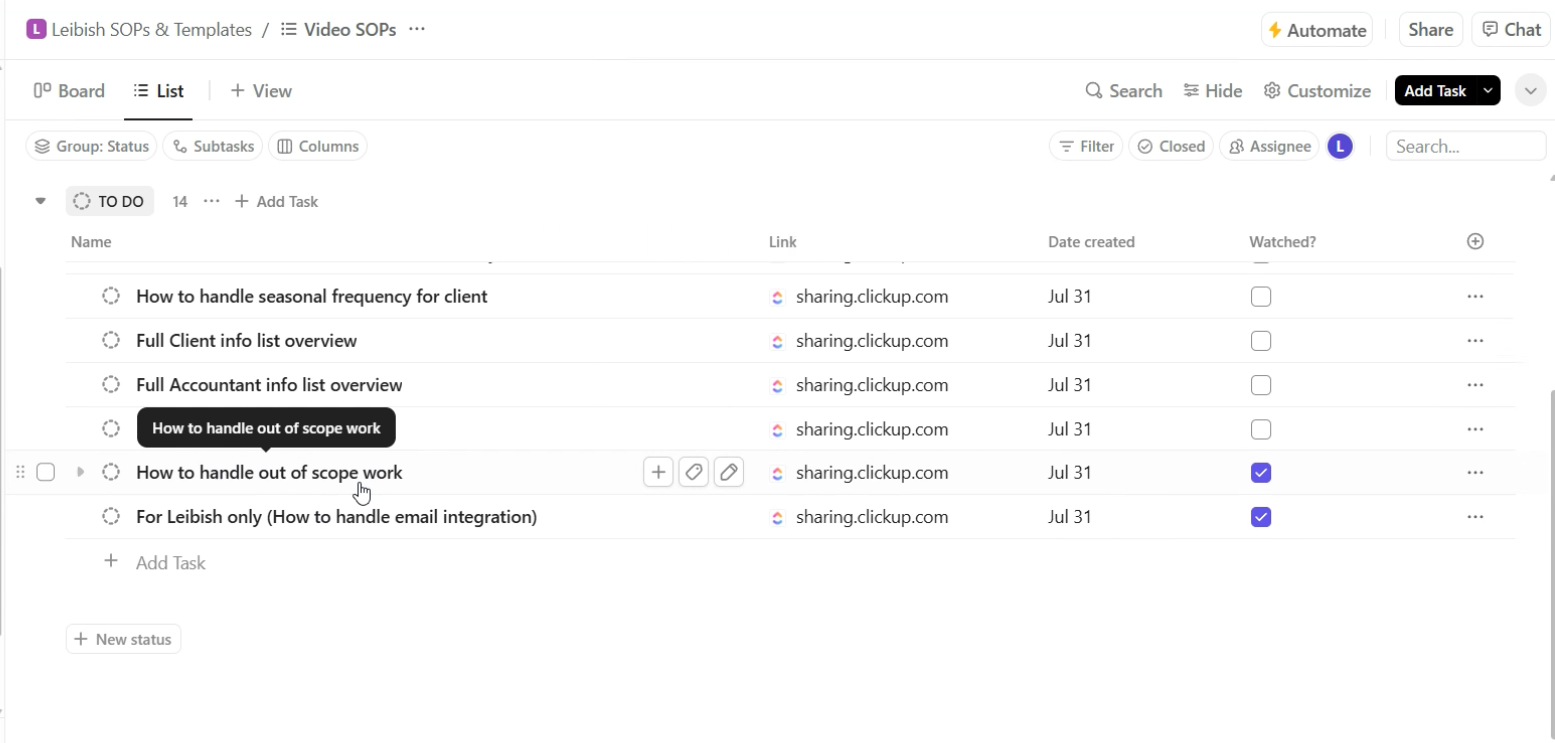
SOPs link directly to tasks so employees have instant access to the information they need. This is the foundation of systemizing any accounting and bookkeeping company – turning tribal knowledge into a scalable asset that doesn’t depend on any single person.
Solution 10: Smart Automations
We implemented dozens of automations including weekend reminders for time-sensitive tasks, dependency chains where year-end closing triggers accountant review tasks, feedback prompts on task completion, overdue alerts when tasks are stuck for more than 10 days, automatic archiving when clients are marked inactive, and entity-type automation that sets correct filing dates based on LLC vs. S-Corp selection.
Each automation removes a small piece of operational chaos. Together, they fundamentally change how the firm operates day to day.
Solution 11: Sprint Points System
To solve capacity planning, we implemented a sprint system inside ClickUp with a dedicated Sprint Dashboard. Each task gets assigned sprint points based on effort, so the team always knows how much work is actually on their plate.
The dashboard shows points assigned versus completed per team member and flags where capacity is maxed out before it becomes a problem. Instead of guessing who has bandwidth for new work, Leibish can see it clearly in one view without asking around or sitting in a meeting to find out.
Full Implementation Summary
- Four-Space Workspace Architecture: Client Fulfillment, HQ, Growth, and SOPs & Templates organizing 137 entities into a logical structure.
- Integrated CRM System: Three interconnected directories (Client Info, Company Info, Accountant Info) with relationship mapping creating a single source of truth.
- Master List Dashboard: Unified view aggregating all tasks with advanced filtering for instant operational visibility.
- Automated Time Tracking: TimelyApp integration capturing work across all applications without manual timer management.
- Profitability Analytics: Real-time profit/loss tracking per client with visual dashboards.
- Seasonal Frequency Automation: Smart task scheduling adjusting automatically based on seasonal patterns.
- Employee Dashboards: Personalized command centers for each team member showing priorities and workload.
- Email Integration: Direct email-to-task conversion with out-of-scope tracking.
- SOP Library: Centralized knowledge base with documented procedures and video walkthroughs.
- Task Dependencies & Automation: Intelligent workflows ensuring proper task sequencing and timely reminders.
- Sprint Points System: Workload measurement framework for capacity planning.
Results in Detail
Over 26 Hours Reclaimed Every Week
Automated time tracking eliminated more than 10 hours of manual timer management. The Master List saved another 10 hours previously spent in status meetings. Seasonal automation reclaimed roughly 5 hours each month. Email integration saved an additional 5 hours in manual task creation. The team now spends these hours on revenue-generating work instead of administrative overhead.
10x More Leads Tracked with the Same Effort
The integrated CRM and automated pipelines allow Leibish Fried & Associates to track ten times the volume of leads with the same team effort. Every inquiry gets logged, categorized, and followed up systematically. No prospects fall through the cracks.
Complete Operational Visibility in Seconds
The Master List gives Leibish Fried & Associates a complete picture of their operation in real-time. Questions like “Which year-end closings are pending?” or “Who has the most overdue tasks?” or “What’s our capacity this week?” get answered in seconds instead of hours.
Strategic Pricing Backed by Real Data
The profit/loss dashboards revealed which clients were most profitable and which needed pricing attention. This data enabled strategic conversations about pricing adjustments and service scope changes backed by real numbers rather than gut feeling.
Happier, More Confident Team
Employees reported that work became significantly more manageable. Clear priorities, instant access to information, SOPs for complex tasks, and objective workload visibility reduced stress and improved retention.
A Foundation Built to Scale
Leibish Fried & Associates now has the systems to grow their client base substantially without proportionally increasing team size. Automated workflows, documented SOPs, capacity dashboards, and streamlined client intake position the firm for confident expansion. This is what it looks like when you truly systemize and automate your accounting and bookkeeping company – growth becomes a choice, not a burden.
Founder Freedom
Leibish no longer spends evenings and weekends managing operational fires. Dashboards show everything he needs to know, systems handle the details, and the team operates independently with confidence.

