
Reading Mode
On This Page
Quick Answer
Hiring a fractional COO is a game-changing decision for businesses aiming to scale efficiently, optimize operations, and navigate complex growth challenges. This comprehensive guide synthesizes insights from top industry experts and platforms to help you recruit the ideal fractional COO for your organization.
Key Takeaways
- Fractional COOs offer strategic agility and cost efficiency for businesses in growth or transition.
- Use specialised platforms (Toptal, Genius) to access pre-vetted talent.
- Focus on candidates with proven metrics, industry expertise, and cultural alignment.
What Is a Fractional COO?
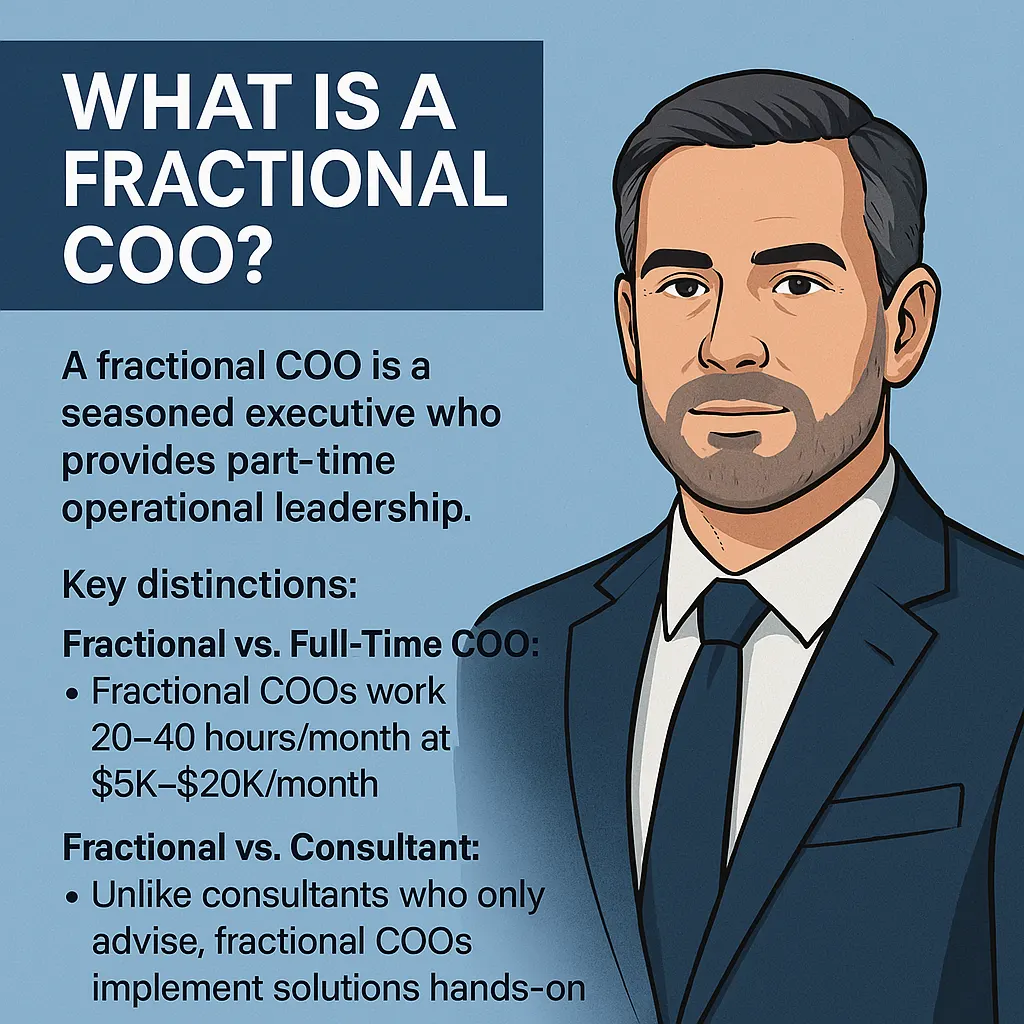
A fractional COO (Chief Operating Officer) is a seasoned executive who provides part-time operational leadership to organizations. Unlike full-time COOs, fractional COOs work on a flexible basis—often 20 to 40 hours per month—and bring a high level of experience without the overhead of a full-time salary. They specialize in strategic execution, team alignment, process improvement, and scaling businesses, making them ideal for startups, SMEs, and companies undergoing rapid growth or transformation.
Key distinctions
Fractional COO vs. Full-Time COO: Fractional COOs typically cost between $5K–$20K/month, while full-time COOs command annual salaries of $250K+ and require long-term commitments.
Fractional COO vs. Consultant: Consultants offer advice; fractional COOs roll up their sleeves and implement solutions.
When to Hire a Fractional COO
5 Signs Your Business Needs One:
Growth Chaos: Your company is scaling, but your internal operations can’t keep up.
CEO Burnout: The founder is bogged down with daily operations instead of focusing on vision and strategy.
Revenue Plateaus: Growth has stagnated due to operational inefficiencies.
Cost Overruns: Rising expenses are eating into your profit margins.
Transitional Phases: Preparing for funding, acquisitions, or major leadership shifts.
Step-by-Step Hiring Process
1. Define Your Needs
Operational Gaps: Identify pain points (e.g., supply chain inefficiencies, team misalignment).
Strategic Goals: Clarify objectives like scaling revenue, reducing costs, or preparing for an exit
2. Source Candidates
Top Platforms to Hire Fractional COOs:
Toptal: Matches businesses with top 3% talent in 48 hours ($200+/hour) 23.
Genius: Rigorous 12-step vetting for cultural and technical fit (25% of first-year salary) 25.
Catalant: Offers 40–60% cost savings vs. traditional consulting ($5K+/project) 2.
InterimExecs: Specializes in rapid executive deployment for turnarounds 2.
GoFractional: Flexible monthly retainers with a 3-month minimum commitment 25.
Pro Tip: Prioritise platforms with industry-specific expertise (e.g., tech, manufacturing, Construction and Healthcare)
3. Evaluate Candidates
Core Qualifications:
Experience: Track record in scaling similar-sized businesses (e.g., 2M–2M–10M revenue) 6.
Skills: Expertise in ERP implementation, financial modeling, or organizational design 6.
Soft Skills: Adaptability, cross-functional leadership, and rapid trust-building 9.
Red Flags: Lack of quantifiable impact (e.g., “Improved EBITDA by X%”) or industry-specific knowledge
4. Conduct Interviews
Key Questions to Ask:
“How did you resolve a major operational bottleneck in a past role?”
“What KPIs do you use to measure operational success?”
“How do you align teams without formal authority?”
5. Start with a Trial
A 90-day trial project lets you assess fit before long-term commitment. Define clear deliverables, like reducing production costs by 15% or implementing a new CRM
Cost vs. ROI
Hourly Rates: 200–200–500/hour 6.
Monthly Retainers: 4K–4K–20K/month 8.
ROI Drivers:
Cost Savings: Fractional COOs reduce overhead by 50–70% vs. full-time hires 6.
Revenue Growth: Optimized processes often boost margins by 20–30%
Pitfalls to Avoid
Vague Scope: Undefined goals lead to misaligned expectations.
Cultural Mismatch: Prioritize candidates who resonate with your team’s values 4.
Overlooking Industry Fit: A manufacturing COO may struggle in SaaS without relevant experience
Sources
- Toptal, toptal.com
- Catalant, catalant.com
- GoFractional, gofractional.com
Frequently Asked Questions
What is a fractional COO?
A fractional COO is a part-time executive leader who helps businesses optimize operations and scale without hiring a full-time COO.
Q: How long does hiring take?
A: 1–4 weeks via platforms like Toptal or Genius
Q: Can a fractional COO become full-time?
A: Yes! Platforms like GoFractional allow transitions for a 15% recruitment fee
Q: What industries benefit most?
A: Tech, manufacturing, healthcare, and PE-backed firms
How to become a fractional COO?
Build a strong operational track record, gain experience across industries, and position yourself as an expert in scaling businesses. Network through platforms like Toptal, Catalant, or GoFractional.
What does a fractional COO do?
They oversee operations, align teams, implement systems, and support CEOs in driving growth. Their hands-on approach sets them apart from traditional consultants.
How much does a fractional COO cost?
Most charge between $200–$500 per hour or $5K–$20K/month, depending on scope, experience, and industry.
How much does a fractional COO make?
Annualized earnings can range from $100K to $300K+, depending on workload and number of clients.

Written By
Founder, Camel Tech
Imrul Hasnat is a two-time founder and the Founder of Camel Tech. With years of experience in SaaS and product management, he has built SaaS products from scratch, combining hands-on expertise in product development, user experience, business process optimization, and scalable systems. He holds industry-recognized credentials as a ClickUp Verified Consultant, Notion Certified Consultant, and monday.com Official Partner, alongside Professional Scrum Master (PSM I) and Professional Scrum Product Owner (PSPO I) certifications. His experience spans product strategy, operational systemization, workflow automation, and AI-driven business transformation.
Subscribe to the SCALEable™ Newsletter
2,000+ business owners getting regular insights on AI tools, systemization, and business scaling. Explore our latest articles.