Reading Mode
On This Page
Quick Answer
Systems Confessions is where founders tell you what actually happened, not the version you see on LinkedIn.
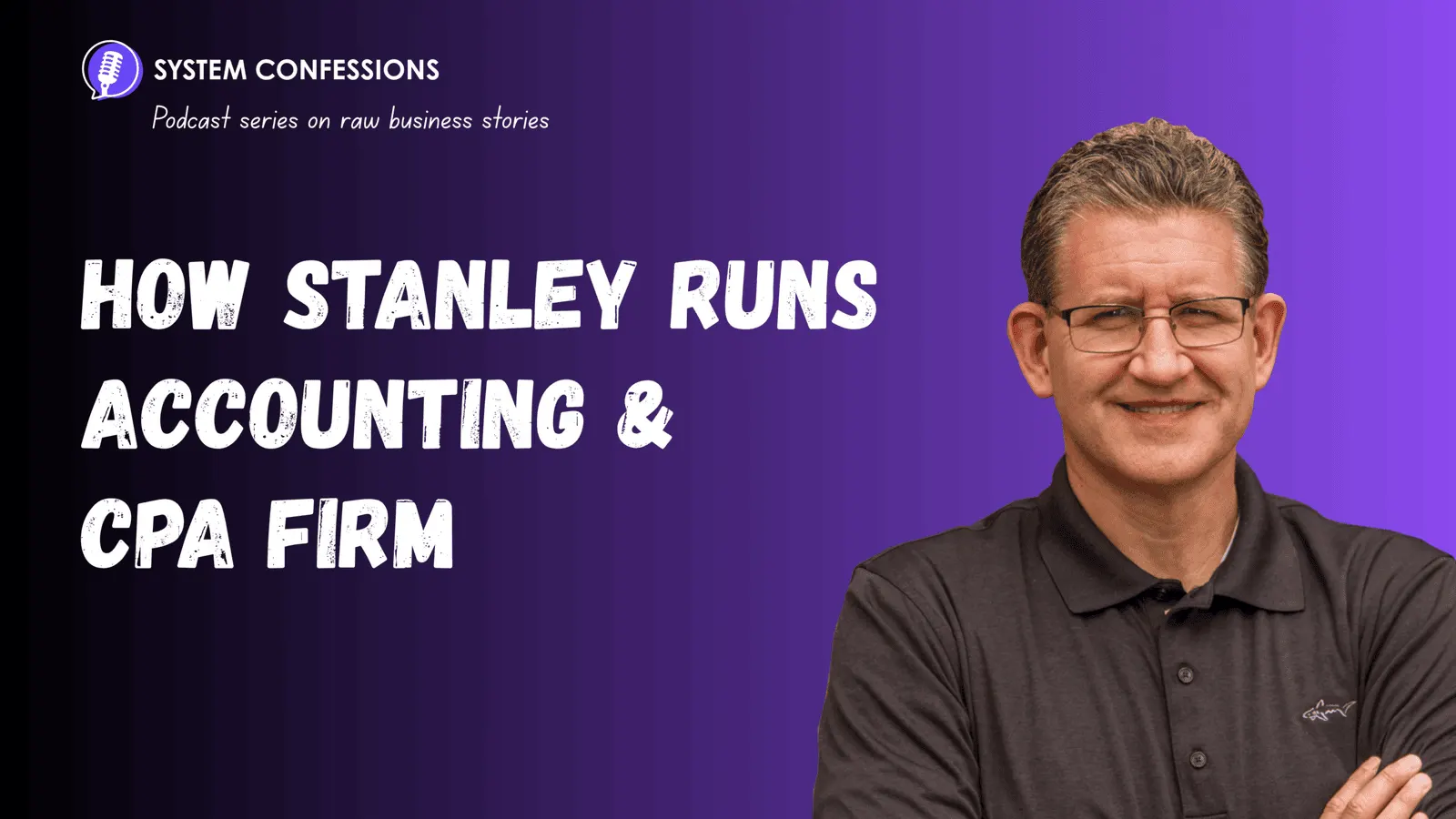
Episode 1 features Stanley Dean, founder of SDA CPA Group based in Dunwoody, Georgia. Stanley spent 23 years building a firm that now serves 75 small business clients monthly, processes around 200 tax returns a year, and runs on a tech stack built around ClickUp, Double, and ChatGPT.
He started with zero clients, zero revenue, and a newborn baby. All in the same month.
Key Takeaways
- Starting a CPA firm from scratch is possible, but the apprentice model is almost always a smoother path than buying or starting cold.
- Niching down to small business clients and dropping individual tax returns can significantly improve profitability and team focus.
- ClickUp outperforms accounting-specific tools for firms that want flexibility in how they design workflows and assign work.
- AI is not replacing accountants. It handles lower-end tasks so accountants can focus on judgment-based advisory work.
- Marketing a CPA firm today means answering the exact questions prospective clients search for, both on your website and in AI tools.
- A chaotic client portal is an operations risk. One missed client message is one too many.
- EOS gives small accounting firms a shared language and system to manage people, vision, and process, not just big companies.
- Hire slow and fire fast. Keeping the wrong person protects no one, not the team, not the clients, and not the firm.
Introduction
Welcome back to Systems Confessions. This is the show where founders tell you what actually happened, not the sanitized LinkedIn version with all the rough edges sanded off.
Today, we have Stanley Dean, founder of SDA CPA Group, based in Dunwoody, Georgia (just north of Atlanta). Our first guest, Stanley, has spent 23 years building a firm that now serves approximately 75 small business clients each month, processes about 200 tax returns, and runs on a tech stack that includes ClickUp, Double, and ChatGPT.
But that is not why you are here.
You are here because of this:
Stanley started his firm with zero clients, zero revenue, and a newborn baby in the same month.
Here is the raw, unedited truth of how he built a $1.3 million systems-driven firm, and why his wife says you should never birth a baby and a business at the same time.
If you are searching for how to build a CPA firm, how to start an accounting firm from scratch, or whether EOS and AI are actually worth it for a small practice, this post covers all of it.
1. The Origin Story: Starting from Zero
Stanley did not take a shortcut to firm ownership. He earned his Master’s in Accounting from the University of Georgia with a tax emphasis, spent five years at PricewaterhouseCoopers (PwC), and then worked another decade in corporate tax, including at a company later acquired by Dow Chemical.
By 2003, he was ready to go out on his own. The original plan was to buy an existing firm, get a book of clients, manage the transition, and start with revenue already coming in. It did not go as planned.
In October 2003, Stanley started from scratch. He joined networking groups, attended chamber meetings, and built the client base one relationship at a time. His first child was born one month before the business launched.
Looking back, what would he do differently? Rather than trying to buy a firm outright, he would have found an owner five to ten years from retirement, joined the firm, built trust with the clients, and transitioned ownership gradually. That is the apprentice model. It is slower, but it would have been smoother.
Twenty-three years later, SDA CPA Group sits at $1.3M in annual revenue with ten people on the team. The lean times were real, but so was the growth.
2. What SDA CPA Group actually do today?
SDA CPA Group is a focused, systems-driven accounting firm that works exclusively with small business owners. Here is a breakdown of what they do:
- Roughly 75 monthly small business accounting clients, all managed through QuickBooks Online
- Around 200 tax returns per year, covering business taxes and owner taxes only
- Approximately 50 payrolls
- A team of 10, including Stanley, his wife Kelly as marketing director, accounting managers, staff accountants, an admin, and offshore support staff
But here is the strategic decision that changed everything: They stopped taking individual tax returns from the general public.
Why this matters for your business: By niching down to business owners, SDA offers ongoing monthly support (predictable, recurring revenue) rather than seasonal chaos. The firm becomes the “CFO for the small business owner,” not just a tax preparer.
If you are searching for “how to niche an accounting firm” or “should my CPA firm stop doing 1040s,” this is your case study.
3. The Tech Stack of a Modern Accounting and CPA Firm
Stanley is a self-described techie. But he doesn’t use the “all-in-one” accounting suites that most firms rely on. He went best-of-breed.
Here is the actual tech stack SDA uses daily
Why ClickUp Over Accounting-Specific Tools?
Most accounting firms use tools like Karbon, Canopy, or Practice CS. Stanley tried them. He found them too rigid. They evaluated Monday.com and ClickUp at the same time and finally went with ClickUp because of ClickUp’s robust time tracking feature. Here is the case study on how they actually implemented ClickUp for their Accounting and CPA firm.
What ClickUp handles for SDA:
- Status of work across 250+ clients
- Task assignment across 10 team members (assembly-line style)
- Checklists for each job (like an airline pilot’s pre-flight checklist)
- Comments as each person works on a file
- Meeting agendas and EOS implementation
For anyone researching “best practice management software for CPAs” or “ClickUp for accounting firms,” Stanley argues that flexibility beats specificity every time.
Note: Camel Tech helped SDA CPA Group build their full EOS system inside ClickUp, replacing their previous ninety.io setup.
4. How Accounting Firms Can Use AI: Threat or Tool?
There is a lot of panic about AI replacing accountants. Stanley has been in the game long enough to have lived through the “TurboTax will kill us” panic, the “QuickBooks will kill us” panic, and now the “AI will kill us” panic.
His verdict?
How SDA Actually Uses AI Today (Not Hype)
The “AI Brain” Concept
At a recent PASBA conference, Stanley learned about creating an “AI brain” within ChatGPT Projects.
The Data Privacy Rule for CPAs Using AI
This is the #1 question every accountant asks about AI. Stanley has a clear answer.
The “It Depends” Answer Remains Irreplaceable
The bottom line: AI will not replace accountants. But accountants who use AI will replace those who don’t. The human judgment and the “it depends” answer remain irreplaceable.
5. How to Market a CPA Firm When Clients Search AI Instead of Google
Consumer behavior has shifted. People are no longer just Googling ‘CPA near me.’ They are asking ChatGPT, Claude, and Gemini directly, and those platforms are pointing them toward service providers.
The Marcus Sheridan Framework
Stanley is adapting by following Marcus Sheridan, author of They Ask You Answer and Endless Customers. Sheridan was the keynote speaker at Stanley’s recent PASBA conference. The core idea: publish honest answers to every question a prospective client might search. For a CPA firm, that looks like:
- What is the difference between a bookkeeper and an accountant?
- Why hire a CPA instead of using TurboTax?
- How much does a small business accounting firm cost per month?
One specific change SDA is making: adding pricing to their website. Most people’s first move on a service website is to look for the pricing tab. If it is not there, trust goes down.
The New Marketing Playbook
Based on Sheridan’s framework, Stanley is implementing:
1. Answer every question a prospect might ask on your website
- What’s the difference between a bookkeeper and an accountant?
- Why hire a CPA vs. doing it yourself with TurboTax?
2. Put your pricing on your website
3.Build an “AI Brain” – load all source documents into ChatGPT Projects so the AI knows exactly who SDA is when answering a user’s query
New Target Market: The Trades
Stanley is pivoting his target market to industries that are less likely to be replaced by AI.
Using Data to Drive Marketing Decisions
Stanley isn’t guessing. He is using ClickUp time data to decide which clients to pursue.
6. How SDA CPA Solved Their Client Communication Problem
One of the most disruptive operational problems at SDA was its old client portal. They were using Copilot (not Microsoft Copilot), and it had a critical flaw.
The problem: A chaotic, messy inbox where messages from all clients got mixed. Things got missed.
The Fix: Double (formerly Keeper)
Why Double works
Before Double, the team would type up questions in Adobe, send them manually, wait for a response, and then update QuickBooks by hand. Double made the whole workflow seamless.
7. How EOS Helps Run a Small Accounting and CPA Firm
Three years ago, Stanley implemented the Entrepreneurial Operating System (EOS) based on the book Traction by Gino Wickman. EOS is not accounting-specific. It is a framework for running any small business more intentionally. Camel Tech helped SDA CPA Group implement EOS in ClickUp so they can replace ninety.io
Key EOS Tools SDA Uses
SDA runs its entire EOS system inside ClickUp, built by Camel Tech. Previously, they used ninety.io. The move to ClickUp consolidated all project management, practice management, and EOS operations into one place.
Their 10-year revenue goal is $5 million. They are currently at $1.3 million, with a new office opened in a high-growth Atlanta suburb, and plans to hire a dedicated salesperson later this year.
8. The Biggest Hiring Mistake Stanley Made in 23 Years
If Stanley could go back to 2003 and give himself one piece of advice, it would not be about tax law or billing rates. It would be about process adherence and people.
For years, SDA operated on a hire slow, fire slow philosophy. They kept people who were not following processes, not because they did not care, but because letting someone go feels costly and uncomfortable. The result was a team that sometimes ignored the systems the firm had worked hard to build.
The #1 People Lesson: Hire Slow, Fire Fast
Stanley admits his biggest mistake was keeping the wrong people for too long.
How EOS Fixed Hiring and Retention
The principle: Systems don’t work if people ignore them. You need written processes (checklists in ClickUp), quarterly one-on-ones to enforce them, and the courage to fire fast when someone is a values mismatch.
The three principles that would have saved him years of pain:
- Write down every process. No exceptions. SDA now has checklists in ClickUp for every recurring job: financial statements, tax returns, payroll. Just like an airline pilot or a surgeon.
- Use quarterly one-on-ones to enforce processes. Not to punish. To ask: “Why is the checklist not being completed? Is the system wrong, or are you the wrong person for this role?”
- Fire fast when someone is a values mismatch. Keeping the wrong person “because you feel bad” hurts the entire team and the clients.
The bottom line: You cannot have a systems-driven firm if you allow people to ignore the systems.
Conclusion
Stanley Dean started in Dunwoody, Georgia, with a newborn baby, zero clients, and no guarantee it would work. Twenty-three years later, he runs a $1.3 million firm with 10 people, a defined niche in trades and small business owners, and a tech stack that uses AI for speed and clarity.
The key takeaway for founders: Systems are not just for the Big 4. They are the only reason a small firm can survive an owner’s vacation, a staff departure, or a recession. EOS, ClickUp, Double, and the discipline to fire fast when someone is the wrong fit- those are the differences between grinding for 23 years and building for 23 years.
What’s Next for SDA CPA Group?
- Revenue goal: $5 million in 10 years (currently at $1.3M)
- New office: Opened in a high-growth Atlanta suburb
- Sales hire: Planning to hire a salesperson later this year
- Marketing overhaul: Implementing Marcus Sheridan’s “They Ask You Answer” framework
- AI expansion: Recording all calls via Zoom Phone, transcribing them, and using that content for social media and meeting prep
Sources
- ClickUp, clickup.com
- Double, trydouble.com
- University of Georgia, uga.edu
- PricewaterhouseCoopers, pwc.com
- Dow Chemical., dow.com
- QuickBooks Online, quickbooks.intuit.com
- Karbon, karbonhq.com
- Canopy, canopytax.com
- Practice CS, tax.thomsonreuters.com
- ninety.io, ninety.io
Frequently Asked Questions
Is AI replacing accountants?
Not according to Stanley Dean, who has been in the industry for over 23 years. He has watched the same prediction play out with TurboTax and QuickBooks, and neither killed the profession. What AI does is handle repetitive, lower-end work so accountants can focus on higher-value advisory work. The judgment required to answer a complex tax question still requires a human.
What software does SDA CPA Group use?
SDA CPA uses QuickBooks Online for client accounting, Ultra Tax for tax return preparation, ClickUp for project and practice management (including their full EOS system), Dropbox for document storage, Double (formerly Keeper) for client communication, Slack for internal messaging, and ChatGPT for marketing and data analysis. Their EOS structure in ClickUp was built by Camel Tech.
What is EOS, and does it work for accounting firms?
EOS stands for Entrepreneurial Operating System, based on the book Traction by Gino Wickman. It gives small businesses a structured way to manage people, vision, data, and process. For SDA CPA, EOS helped them set a 10-year revenue goal and break it into quarterly priorities called Rocks. It also gave them a clearer hiring and people-management framework through tools like GWC (Get it, Want it, Capacity) and quarterly one-on-ones.
Should a CPA firm stop doing individual tax returns?
That depends on your strategy. For SDA CPA, stopping individual returns (except for clients who also own a business) was a straightforward profitability decision. Individual returns are seasonal, one-time work. Monthly small business clients generate recurring revenue and allow the firm to build deeper relationships. If your goal is a scalable, predictable firm, niching down to business owners is worth considering.
How do you get your CPA firm found on ChatGPT and AI search tools?
Publish clear, honest answers to every question your prospective clients ask. Marcus Sheridan's They Ask You Answer framework is the playbook Stanley is following. That means answering pricing questions openly on your website, explaining the differences between your services, and building out an AI Brain inside ChatGPT Projects with your firm's information loaded in. When AI tools look for a recommended service provider, they pull from published content. If your content is helpful and specific, you are more likely to be surfaced.
What is the apprentice model for starting a CPA firm?
Rather than buying a firm outright or starting from scratch, the apprentice model involves joining a firm whose owner plans to retire in five to ten years. You spend those years learning the operations and building trust with the clients. When the owner steps back, you take over a book of business that already knows you. Stanley says this is the path he wishes he had taken when starting SDA CPA Group in 2003.

Written By
Founder, Camel Tech
Imrul Hasnat is a two-time founder and the Founder of Camel Tech. With years of experience in SaaS and product management, he has built SaaS products from scratch, combining hands-on expertise in product development, user experience, business process optimization, and scalable systems. He holds industry-recognized credentials as a ClickUp Verified Consultant, Notion Certified Consultant, and monday.com Official Partner, alongside Professional Scrum Master (PSM I) and Professional Scrum Product Owner (PSPO I) certifications. His experience spans product strategy, operational systemization, workflow automation, and AI-driven business transformation.
Subscribe to the SCALEable™ Newsletter
2,000+ business owners getting regular insights on AI tools, systemization, and business scaling. Explore our latest articles.