
A Complete Guide on Monday.com Vibe Coding (2026)

Imrul Hasnat
Founder, Camel Tech
- Last Updated:September 16, 2026
15 mins read
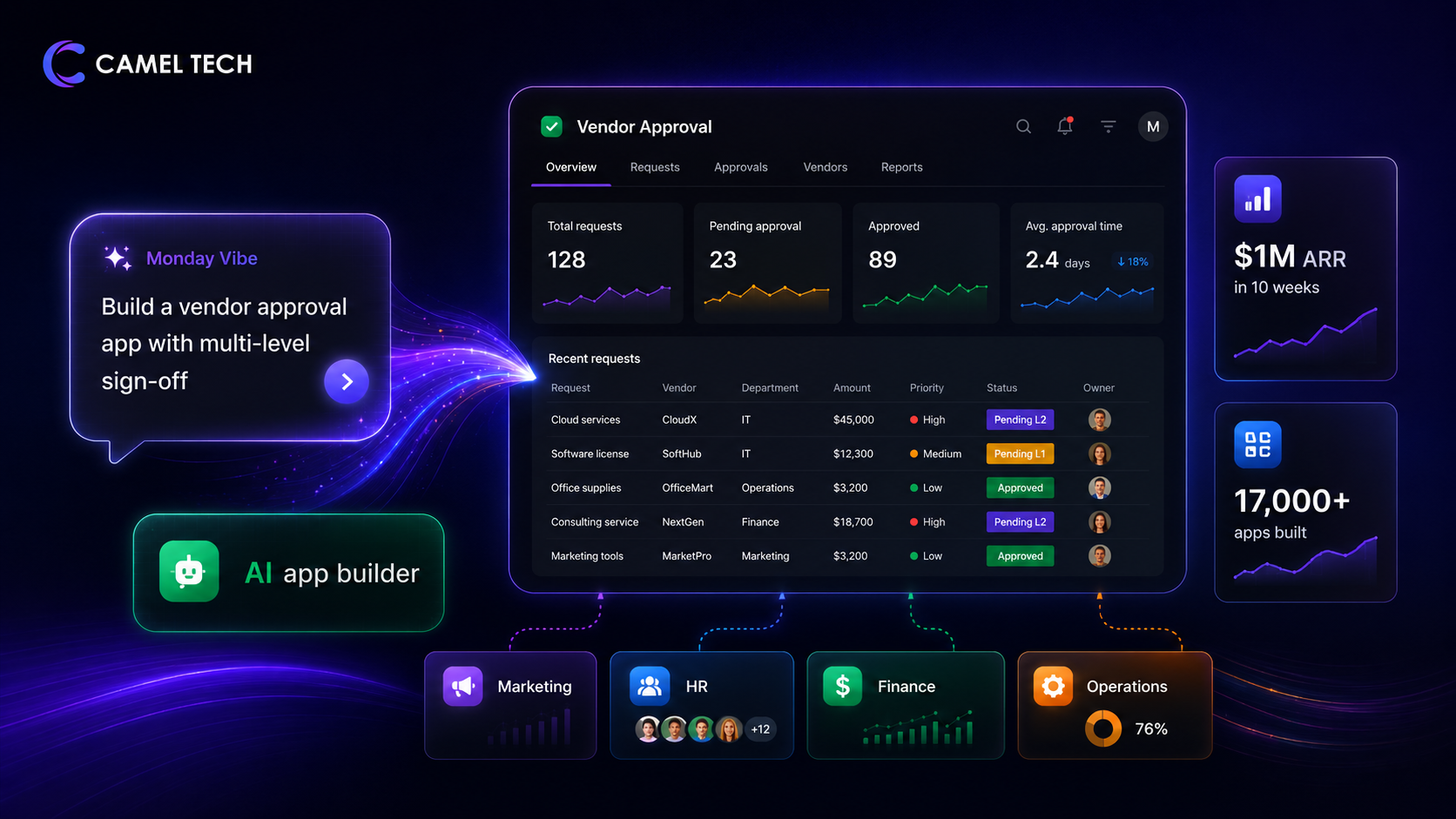
Table of Contents
Quick Answer
Monday Vibe is Monday.com’s AI-powered no-code app builder that turns plain-language descriptions into fully functional enterprise applications. It crossed $1M ARR in approximately 10 weeks (2.5 months from the mid-October 2025 pricing launch), faster than any product in Monday.com’s history. Monday CRM, which later reached $100M ARR, was the prior benchmark. More than 17,000 apps were built within just two months of launch.
Here’s why it matters, who it’s for, and what the hype is actually built on.
Why Trust This Content
Most articles about Monday Vibe are written by people who watched a demo or read a press release. This one isn’t.
At Camel Tech, we are a Monday Official Partner and have implemented Monday.com, Notion, and ClickUp across 80+ businesses – agencies, construction firms, accounting practices, e-commerce stores, and professional services companies. We’ve helped teams adopt Monday Vibe, Monday Magic, and the broader Monday AI stack. See our full client results. For example, we built a Monday.com system for Keystone Custom Decks to automate their spa order management and save them 10 hours per week. We’ve seen what works, what doesn’t, and where the real value shows up.

All data in this guide is verified as of June 2026, drawn from Monday.com earnings calls, official announcements, G2 reports, and our own implementation experience.
Key Takeaways
- What it is: Monday Vibe is an AI-powered no-code app builder inside Monday.com that turns plain‑language descriptions into fully functional enterprise applications.
- How fast it grew: It crossed $1M ARR in just 10 weeks, faster than any product in Monday.com history. Monday CRM, which later reached $100M ARR, was the prior benchmark. Over 17,000 apps were built in the first two months.
- Who it’s for: Non‑technical business users (marketing, HR, finance, operations) who need to build internal tools without waiting for IT.
- What you can build: Campaign dashboards, HR onboarding portals, multi-level approval systems, vendor management tools, time trackers, org charts, project risk monitors, and anything that maps to Monday’s data model.
- How it works: You type a prompt (e.g., “Build a vendor approval system with multi‑level sign‑off”), and Vibe generates the app. You can iterate conversationally with prompts like “switch to a light theme” or “add a weekly summary chart,” and the app updates instantly.
- Pricing: Monday Vibe bills on two separate credit rates depending on the type of action. Building and editing prompts consume credits per message, with costs ranging from approximately 10 credits (Gemini Flash, simple tasks) to 30 to 50 credits (Claude Sonnet, the default) to up to 500 credits (Claude Opus, for complex multi-page apps). Vibe auto-selects the model based on complexity unless you choose manually. Runtime AI actions inside a published app (such as text translation or content generation triggered when team members use the app) consume 8 credits per AI call, plus 2 credits per triggered integration such as a Gmail or Outlook sync. Customers who purchase AI credits receive free live apps per plan: Basic (1), Standard (2), Pro (3), Enterprise (5). Draft mode incurs no publishing fee, but AI build prompts still draw from the credit pool.
- Security & governance: Apps are built on Monday’s enterprise infrastructure with role-based access control, granular permissions, automatic mobile responsiveness, and private by default with deliberate sharing controls.
- Limitations: Apps cannot be exported (platform lock‑in). The cost is significant for very small teams. Highly complex custom logic may still require traditional development.
- Strategic importance: Vibe coding is a shift from “no‑code” to “describe and build.” It empowers citizen developers, raises switching costs for Monday customers, and positions Monday.com as a work execution platform rather than just a work management tool.
- Market context: Gartner projects 75% of new application development will use low-code tools by 2026, up from 40% in 2021. The low-code market is projected to reach $187B by 2030. Monday Vibe is one of the first enterprise‑grade implementations of vibe coding inside a work OS.
- Camel Tech authority: As a Monday Official Partner with 80+ implementations, Camel Tech helps businesses adopt Monday Vibe and the broader Monday AI stack.
What is Vibe Coding?
Vibe coding is a software development approach where you describe what you want in plain language, and AI generates the code. The term was coined by Andrej Karpathy, a co-founder of OpenAI and former Director of AI at Tesla, in February 2025 to describe the paradigm shift away from manual syntax writing toward conversational, intent-driven building. The phrase has since been named Collins Dictionary’s 2025 Word of the Year.
Unlike traditional no-code tools that still require you to drag-and-drop components, vibe coding removes the need for structural knowledge entirely. You only need to know what you want, not how to build it.
What Is Monday Vibe, and How Does It Work?
Monday Vibe is an AI-powered app builder embedded inside Monday.com that lets anyone, regardless of technical background, create custom business applications by describing what they want in plain language.
No drag-and-drop. No code. No waiting six months for IT. You type a prompt like “Build a vendor approval system with multi-level sign-off and an automatic CFO notification when budget overrun exceeds $10,000.” Vibe then generates a working application.
From there, the interaction stays conversational. You can say things like “switch to a light theme,” “connect data from four boards,” or “add a weekly summary chart,” and the app updates in real time. The entire experience is iterative, human, and fast.
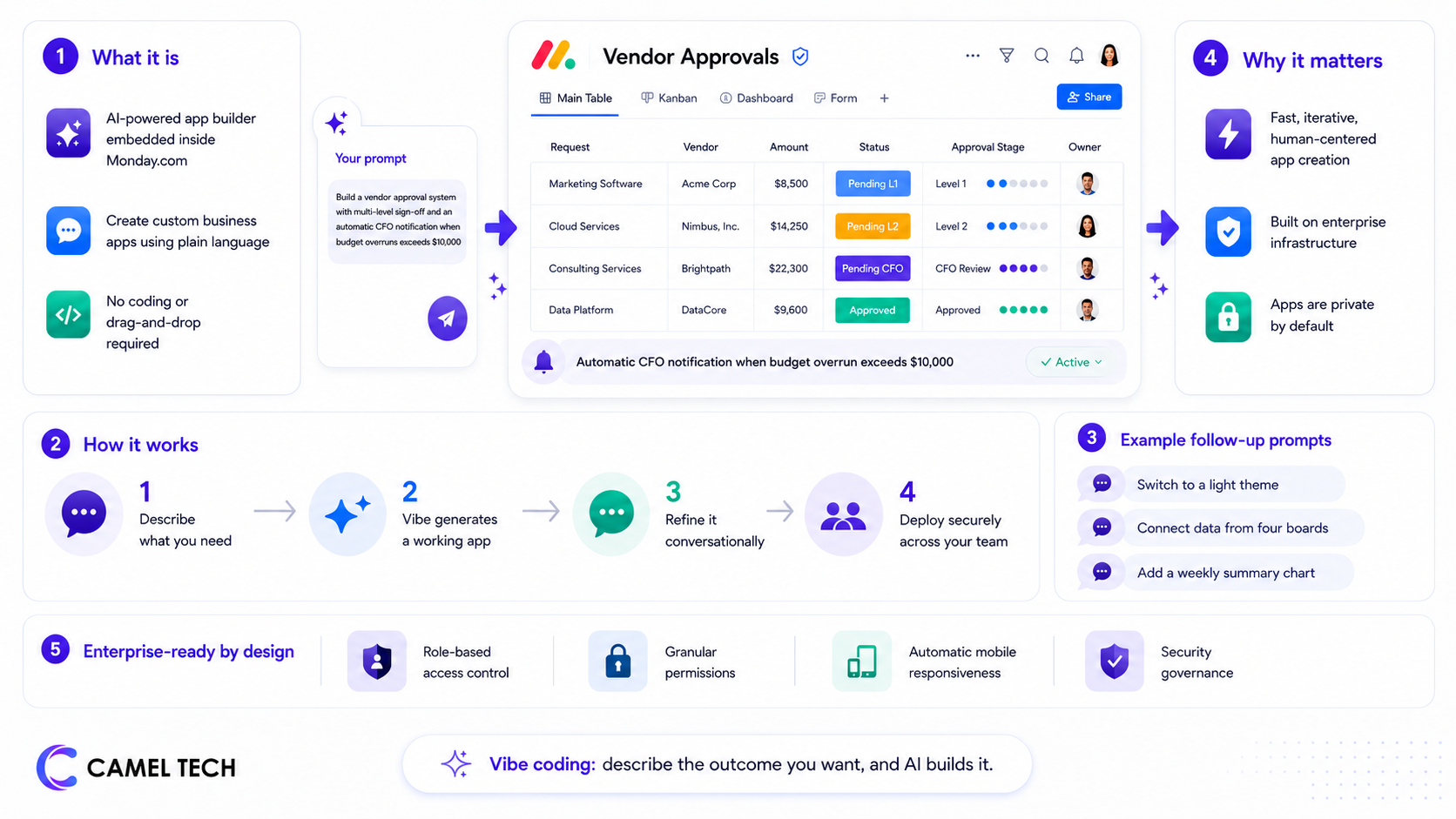
What makes Monday Vibe more than a novelty is what happens behind the scenes: every app is built on Monday.com’s enterprise infrastructure, which includes role-based access control, granular permissions, automatic mobile responsiveness, and security governance out of the box. Apps are private by default. Sharing is deliberate.
Monday Vibe is the first enterprise-grade implementation of vibe coding embedded inside a work operating system.
How Is Monday Vibe Different from Monday Magic?
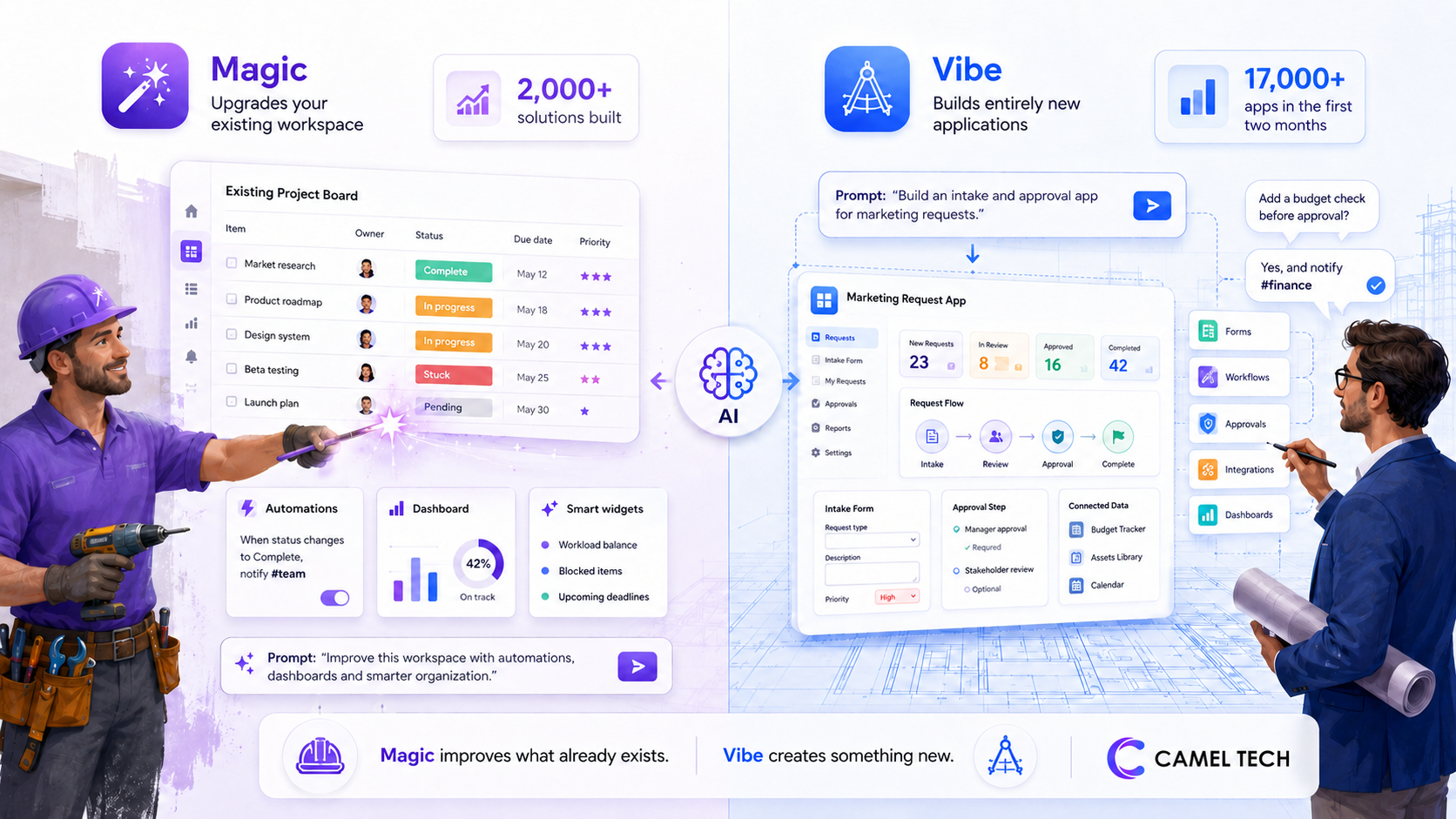
Monday Magic generates boards, automations, and dashboards from a single prompt. Monday Vibe builds entirely new applications from scratch. They solve different problems.
Think of it this way: Magic is the renovation contractor that takes your existing Monday workspace and makes it smarter, faster, and more complete. Vibe is the architect, creating something new that didn’t exist before.
| Feature | Monday Magic | Monday Vibe |
|---|---|---|
| Purpose | Enhance existing workflows | Build brand-new applications |
| Input | Prompt to generate a board | Prompt to generate an app |
| Output | Boards, automations, forms, dashboards | Dashboards, portals, trackers, approval systems |
| Pricing | Included in paid plans, no credits | Credit-based (post-May 6, 2026) |
| Adoption | ~2,000 solutions built | 17,000+ apps in 2 months |
| Best for | Teams wanting smarter existing workflows | Teams needing entirely new internal tools |
| Use case | “Set up a content calendar for my team” | “Build an onboarding portal with document collection and compliance alerts” |
Magic reached over 2,000 solutions built within months of launch. Vibe surpassed 17,000 apps within its first two months. Both are AI features, but Vibe is the one generating the bigger strategic conversation – because it changes who can build software, not just who can use it.
What Can You Actually Build with Monday Vibe?
You can build virtually any internal business tool: campaign dashboards, HR onboarding portals, multi-level approval systems, vendor management tools, time trackers, org charts, project risk monitors – all without writing a line of code.
The range of what teams are already building breaks down roughly like this:
Marketing and Sales teams are building campaign performance dashboards that pull real-time data from CRM and ad platforms, and lead attribution models that previously would have required a data engineer to set up.
HR teams are creating branded onboarding and offboarding portals – complete with automated document collection, task checklists, and rule-based alerts for compliance milestones such as probation end dates or required training windows.
Finance and Procurement teams are replacing spreadsheet-based approval chains with multi-level systems that connect general ledger codes, departmental budgets, and vendor records – without writing a single formula or API call.
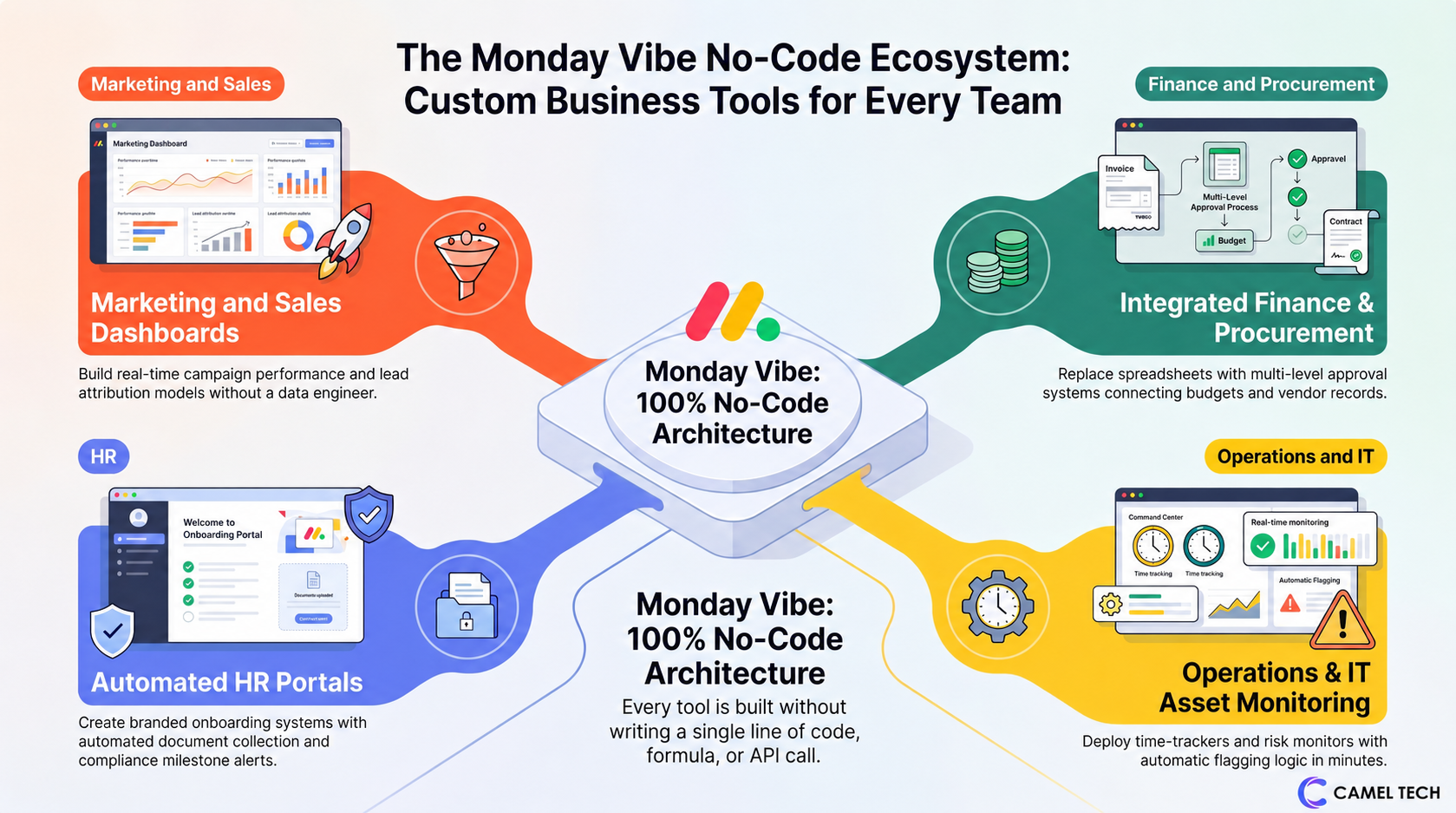
Operations and IT teams are spinning up time-tracking dashboards, asset registers, and project risk monitors with automatic flagging logic that previously required a developer and a two-week sprint to build.
Daniel Lereya, CPTO at Monday.com, described the pattern he kept seeing after launch: people taking this capability and fundamentally changing how their business operates – building solutions on their own, with immediate time to value.
Not sure which Vibe apps would save your team the most time? Camel Tech helps businesses identify high‑impact automation opportunities. Start with a free consultation →
How Much Does Monday Vibe Cost?
Monday Vibe pricing changed fundamentally on May 6, 2026. The current model bundles Vibe app publishing with Monday’s AI Credits system, replacing the previous flat-rate add-on tiers of $100 per month for 10 apps and $250 per month for 25 apps.
Under the new model, Monday Vibe bills along two distinct dimensions depending on the type of usage. Building prompts (messages sent to the AI during app creation and editing) consume approximately 30 credits per message, with Vibe auto-selecting the AI model based on prompt complexity. Runtime AI actions inside published apps, such as text translation, content generation, or summarization, triggered when team members use the app, consume 8 credits per AI call. Integration triggers from within a Vibe app, such as a Gmail or Outlook sync, consume an additional 2 credits each. Customers who purchase AI credits also receive a fixed number of free live (published) Vibe apps tied to their Monday.com plan tier.
This distinction matters more than most pricing breakdowns acknowledge. Build prompts consume AI credits from the moment you type them, whether the app is in draft or published. The distinction that matters is between building (prompts sent to the AI) and runtime (AI actions triggered by your team inside a live app). Both consume credits, but at different rates. Draft mode carries no publishing fee, but build prompts draw from your credit pool from the first message. The real cost distinction is between building (credits per prompt) and publishing (free up to your plan’s app allowance, or the standalone add-on for more). You can build, validate, and experiment before deciding whether to publish.
Here’s the full picture:
- Building private apps: consumes AI credits per prompt (10 to 500 credits depending on model and complexity)
- Basic plan: 1 free live (published) Vibe app
- Standard plan: 2 free live (published) Vibe apps
- Pro plan: 3 free live (published) Vibe apps
- Enterprise plan: 5 free live (published) Vibe apps
- AI credit consumption: approximately 30 credits per Vibe message
- Available on: all paid Monday.com plans (Basic, Standard, Pro, Enterprise)
- Not available on: the free plan
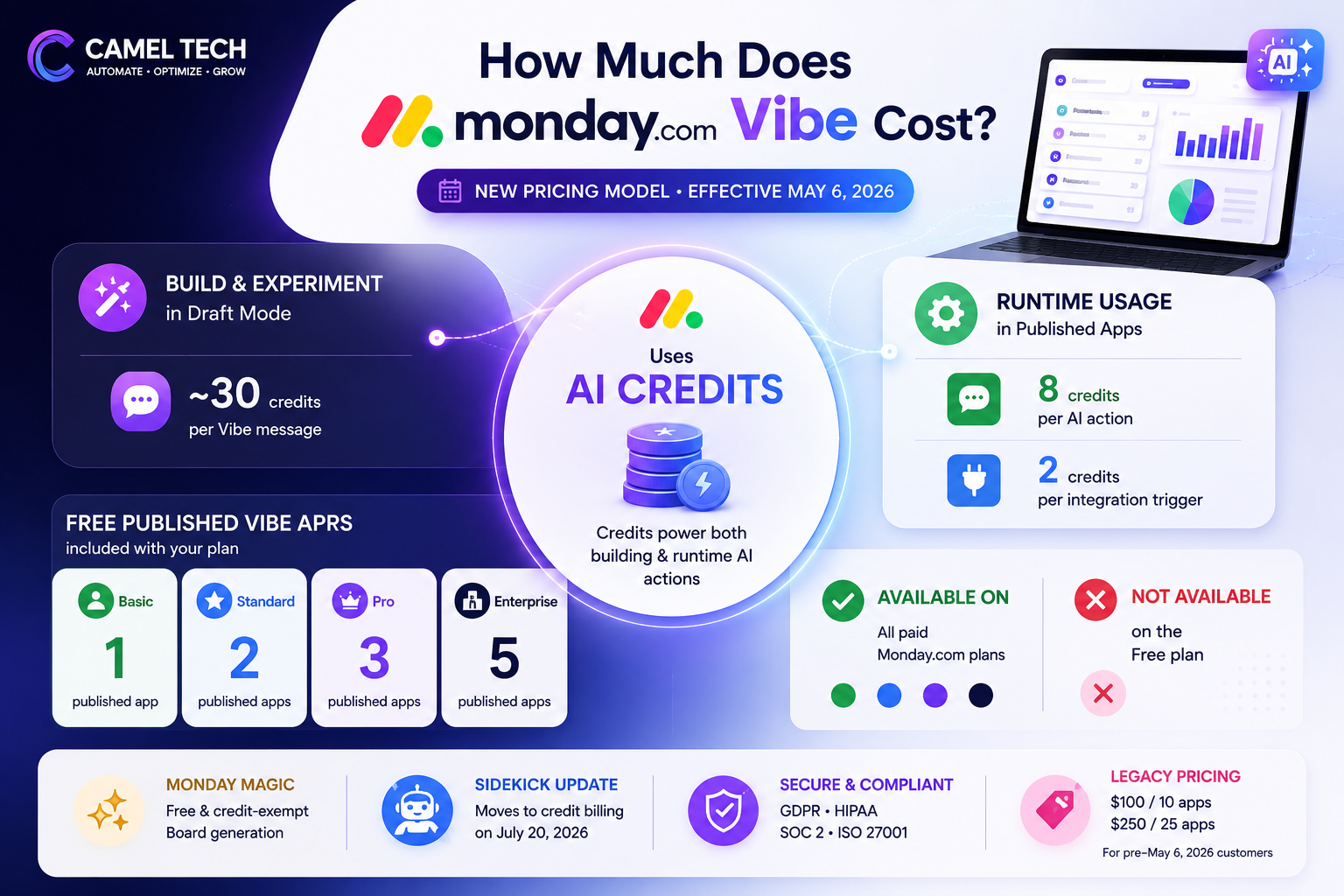
Monday Magic is free and credit-exempt: The board-generation feature is included in all paid plans at no extra cost and does not consume AI credits. It works as a no-cost complement to Vibe, not a replacement.
Sidekick moves to credit billing on July 20, 2026: Beginning that date, Monday, Sidekick will consume AI credits based on the complexity of each interaction. If your team uses Sidekick heavily, factor this into your monthly credit planning alongside Vibe usage.
Note for those who joined before May 6, 2026: This pricing model applies to customers who joined on or after that date. If you signed up earlier, you may still be on the legacy $100/$250 add-on pricing. You can stay on that structure or contact Monday support to transition to the credit-based model.
Why Is Vibe Coding a Big Deal for Businesses Right Now?
Gartner projects that by 2026, 75% of new application development will use low-code tools, up from 40% in 2021. Vibe coding takes this further by removing the technical barrier entirely.
The underlying problem is well-documented but rarely stated plainly: the people who best understand business problems are rarely the people who can build solutions to them. A finance manager who knows exactly what a cash flow dashboard needs has always had to translate that knowledge into a developer’s backlog – and wait. Sometimes weeks. Sometimes months. Sometimes indefinitely.
Vibe coding collapses that gap. The business user is the builder. The constraint shifts from “can we build this?” to “have we described what we need clearly enough?”
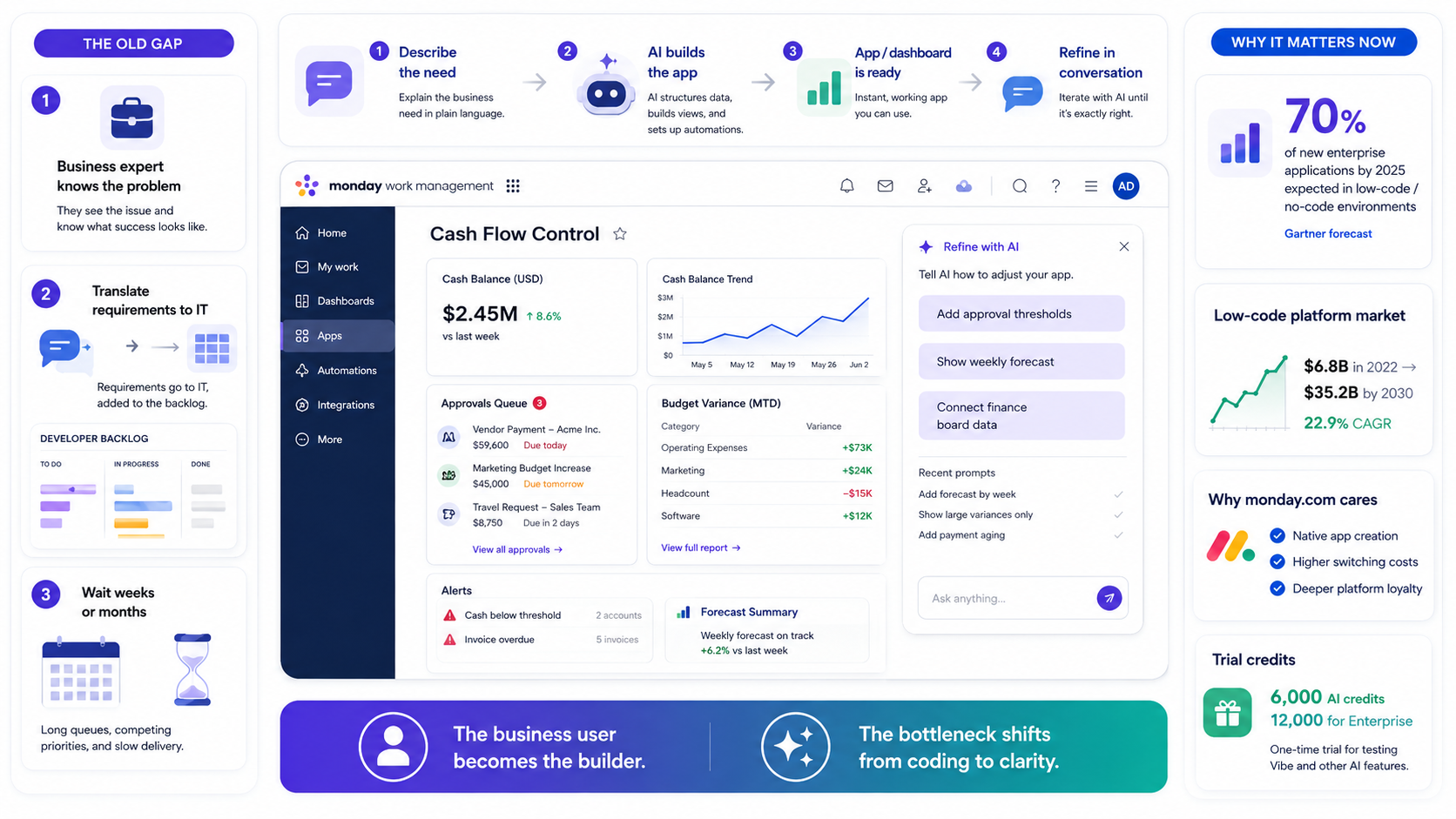
The market data reinforces the momentum. The global low-code development platform market was estimated at approximately $50 billion in 2025 and is projected to reach $187 billion by 2030, according to P&S Intelligence, at a compound annual growth rate of roughly 31%. Vibe coding, as a natural evolution of no-code, is positioned to capture a significant share of that growth.
For Monday.com specifically, vibe coding is also a strategic defense move. AI is an existential threat to platform companies – in theory, sufficiently advanced AI could help any team build custom software without needing any platform at all. Monday Vibe is the counterargument: by making app creation native to Monday’s infrastructure, switching costs increase and platform loyalty deepens.
Important note for new users: New customers signing up after May 6, 2026, receive a minimum AI credit allocation as part of their plan purchase, giving teams immediate access to test Vibe, Sidekick, and other AI features.
Is Monday Vibe Actually Working? The Adoption Numbers
Yes – and the numbers are more remarkable than most coverage has acknowledged. Monday Vibe is the fastest product in Monday.com history to reach $1 million in annual recurring revenue.
For context: Monday CRM, which went on to reach $100 million ARR over three years, was previously the benchmark for fast growth inside the company. Vibe surpassed it.
Co-CEO Eran Zinman confirmed this milestone on the Q4 2025 earnings call, citing Vibe explicitly as evidence that the company’s AI execution strategy is paying off.
The usage metrics support the financial signal. The usage metrics support the financial signal. Organic app creation, rather than managed enterprise rollout, is the primary driver of that traction.
There’s also a strategic stickiness dynamic at play here. Once a team builds internal tools on Monday Vibe, the switching cost increases meaningfully. The apps live inside Monday’s ecosystem – they can’t be exported. The deeper an organization integrates Vibe into its daily operations, the more its workflows are tied to Monday.com’s infrastructure. That’s a deliberate design decision, and from a retention standpoint, it appears to be working.
G2 social proof: Monday.com holds a 4.7-star average from over 18,000 verified G2 reviews, one of the highest review counts in the project management category.
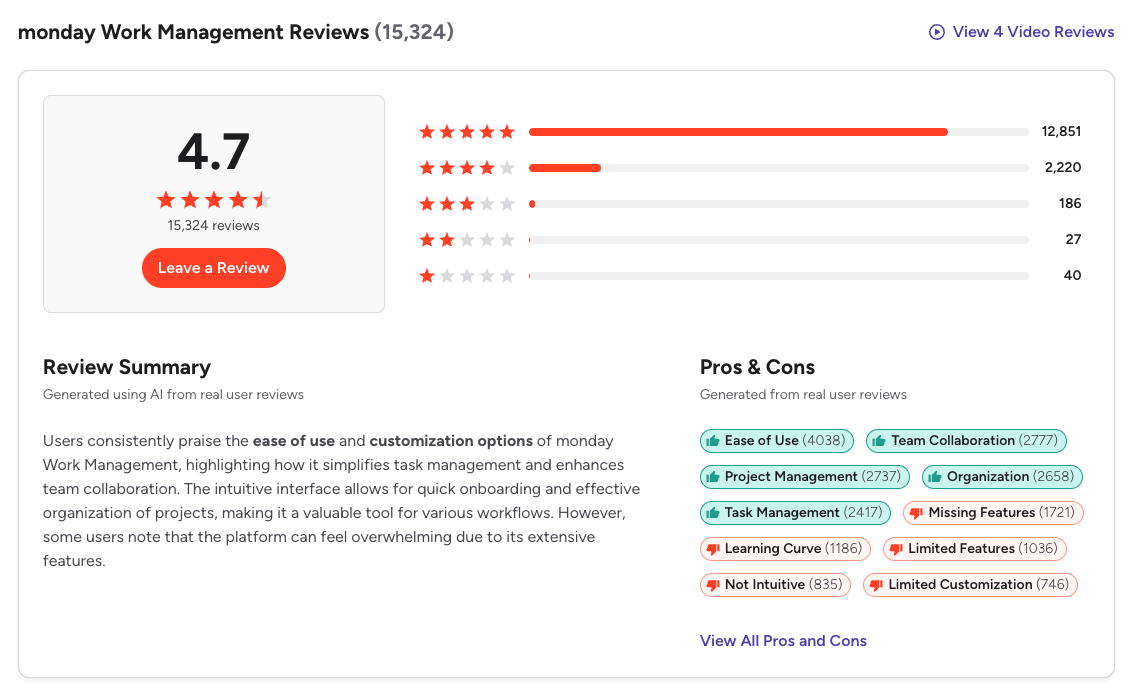
While Vibe-specific reviews are still emerging, the platform’s overall user satisfaction signals a receptive audience for its AI features.
By comparison, Microsoft Copilot, widely regarded as the biggest AI product launch in enterprise software in years, has been adopted by just 3% of its commercial productivity suite customers. Monday Vibe’s traction is notably stronger relative to its base.
How Does Monday Vibe Compare to Other Vibe Coding Tools?
Monday Vibe is the only enterprise-grade vibe coding tool built natively inside a work operating system. Tools like Lovable, Bolt.new, and Replit generate exportable code. Cursor takes a different angle entirely: it is an AI-assisted code editor for developers who already write code and want AI inside their existing workflow, not a prompt-to-app builder. Vibe generates apps, and the distinction has real consequences for enterprise buyers. Read more on Notion VS Monday.com
| Feature | Monday Vibe | Lovable | Bolt.new | Replit | Cursor |
|---|---|---|---|---|---|
| Target user | Non-technical business users | Product managers, non-devs | Developers | Developers | Professional developers |
| Output | Apps inside Monday.com, no export | Exportable full-stack code | Exportable full-stack code | Exportable code | AI-assisted code within any existing codebase |
| Security | Enterprise-grade, built-in | User-managed | User-managed | User-managed | User-managed; Business plan adds enforced privacy mode |
| Integration | Native with Monday.com | External via API | External via API | External via API | Works with any codebase, framework, or external service |
| Pricing | Free to build private apps; $10/app/mon to publish, or free (1 to 5 apps) with AI credit package (~$0.01/credit); requires Monday.com plan from $9/seat/mon | Freemium, ~$20 to $50/month | Freemium, ~$20 to $50/month | Freemium, ~$25 to $100/month | Hobby free; Pro $20/mon; Business $40/user/mon |
| Best for | Internal business tools | Startups, MVPs | Dev-adjacent users | Full-stack development | AI pair programming within existing developer workflows |
Lovable crossed $500 million ARR by mid-2026 (from $400M in February), having reached $100M ARR in just eight months from launch having reached $100M ARR in just eight months from launch- the fastest software company in history to hit that milestone at the time, with over 100,000 new projects built daily on the platform. The market appetite for AI-generated applications is real and growing fast. But Lovable’s target user is closer to a technical founder building a startup MVP than a marketing manager building a campaign tracker. These are adjacent but distinct use cases.
| Tool | Output | Best For | 2026 Scale |
|---|---|---|---|
| Monday Vibe | Apps inside Monday.com | Non-technical business users | 17,000+ apps in 2 months |
| Lovable | Standalone web apps with exportable code | Founders building MVPs | $400M ARR by Feb 2026 |
| Bolt.new | Browser-based full-stack apps | Shareable prototypes | Owned by StackBlitz |
| Replit | Browser code + AI agent | Technical builders | $253M ARR by Oct 2025 |
| Cursor | AI-embedded code editor | Developers | $2B ARR by February 2026, scaling from $100M in January 2025 to $1B by November 2025 to $2B in just 13 months. Forecasting $6B+ ARR by end of 2026; currently in talks to raise $2B at a $50B valuation |
The core trade-off is exportability versus integration. Lovable and Bolt give you code you own and can deploy anywhere. Monday Vibe gives you an app that lives inside your existing workflows, governed by your existing permissions, with no infrastructure to manage. For enterprise buyers, that second value proposition is often more compelling than the first. If you’re still weighing the broader platform decision before going deeper into Monday’s AI stack, our ClickUp vs Monday.com comparison covers how the two platforms differ at the foundation level.
What Are the Actual Limitations of Monday Vibe?
Three genuine limitations worth knowing before you commit: the publishing cost is real for small teams, everything stays inside Monday’s ecosystem, and highly complex custom logic may still require a developer.
Cost for smaller teams. Under the new credit-based model, costs scale with usage rather than per-app, which can be more or less favorable depending on team size. The free private app tier helps because you can build and validate before publishing, but the cost floor is real once you’re ready to share.
Platform lock-in. Apps built with Monday Vibe live inside Monday.com and cannot be exported as standalone software. This is by design. If your organization ever migrates away from Monday.com, those apps don’t come with you. Unlike Lovable or Bolt.new, which generate ownable, portable code, Vibe is a closed system.
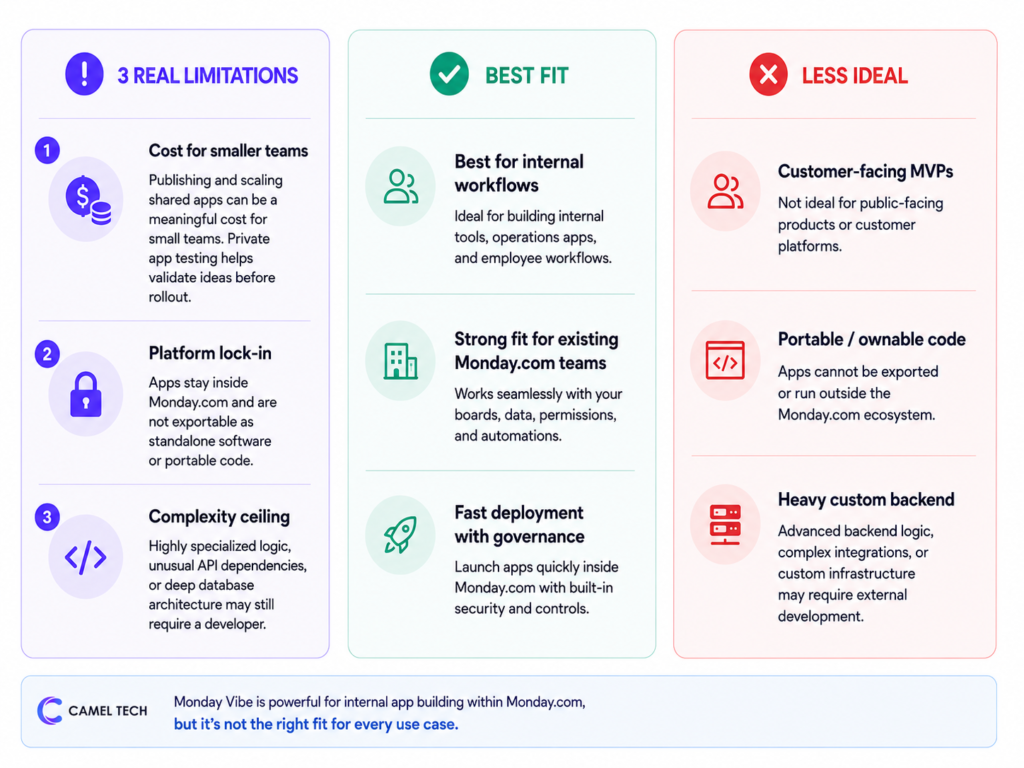
Complexity ceiling. For applications with highly specialized logic, unusual external API dependencies, or deep database architecture requirements, full-code development is still likely necessary. Monday Vibe excels at business tools that map to Monday’s data model. It’s less suited to building, say, a custom ML inference pipeline or a deeply integrated ERP extension.
None of these are dealbreakers for the target user: non-technical business professionals building internal tools within an existing Monday.com environment. But they’re worth understanding before you start.
Vibe isn’t for every use case. Camel Tech provides honest, no‑pressure assessments – we’ll tell you if Vibe (or another tool) fits your business. Start with a free consultation →
Who Should Use Monday Vibe?
Monday Vibe is best suited for teams that are already on a paid Monday.com plan, have non-technical business users who need to build internal tools, and are ready to budget AI credits for publishing live apps beyond their plan’s free allowance.
Specifically, consider Monday Vibe if:
- Your team already uses Monday.com for daily work (CRM, project tracking, or operations). See how Camel Tech implements Monday.com.
- You have recurring business processes that still rely on spreadsheets, email chains, or manual approvals.
- You want to empower marketing, HR, finance, or operations staff to build their own solutions without waiting for IT.
- You are a mid-market or enterprise organization with a budget for AI credits and a willingness to invest in citizen development.
- You value integration with existing Monday data and permissions over owning exportable code.
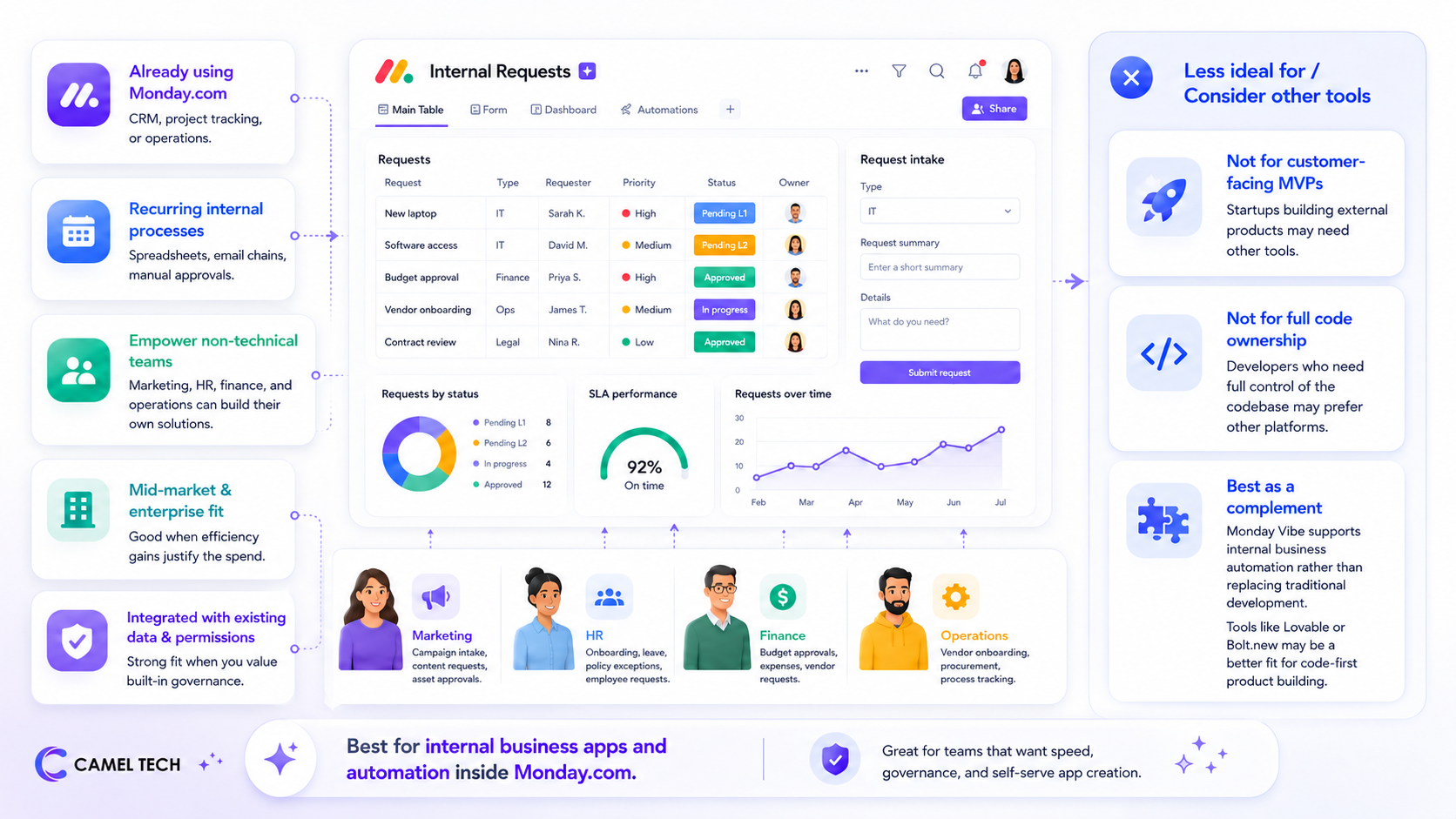
If you are a startup building a customer-facing MVP or a developer who needs full control over the codebase, tools like Lovable or Bolt.new may be a better fit. If you are a professional developer who writes code daily and wants AI pair-programming inside your existing IDE, Cursor is worth evaluating.
Where Does Monday Vibe Fit in Monday.com’s Broader AI Strategy?
Monday Vibe is one piece of a larger AI bet Monday.com is making in 2026 – a pivot from “work management platform” to “work execution platform.”
The full AI stack that Monday has built or launched recently includes:
Monday Magic – one prompt generates a complete board with automations and dashboards. Over 2,000 solutions were built within months of launch.
Monday Sidekick – a context-aware AI assistant that came out of beta in January 2026. Now expanded with cross-platform actions across Slack, Gmail, and Google Calendar, and moving to credit-based consumption on July 20, 2026. Now expanded with a Skills Marketplace that lets Sidekick operate across your full tech stack, not just inside Monday.
Agent Factory – a standalone no-code agent builder for creating an autonomous digital workforce.
Monday Campaigns – AI-driven marketing functionality built directly into Monday CRM.
Claude Connector – direct integration with Claude AI inside Monday workflows, signaling that Monday is serious about third-party AI models, not just its own.
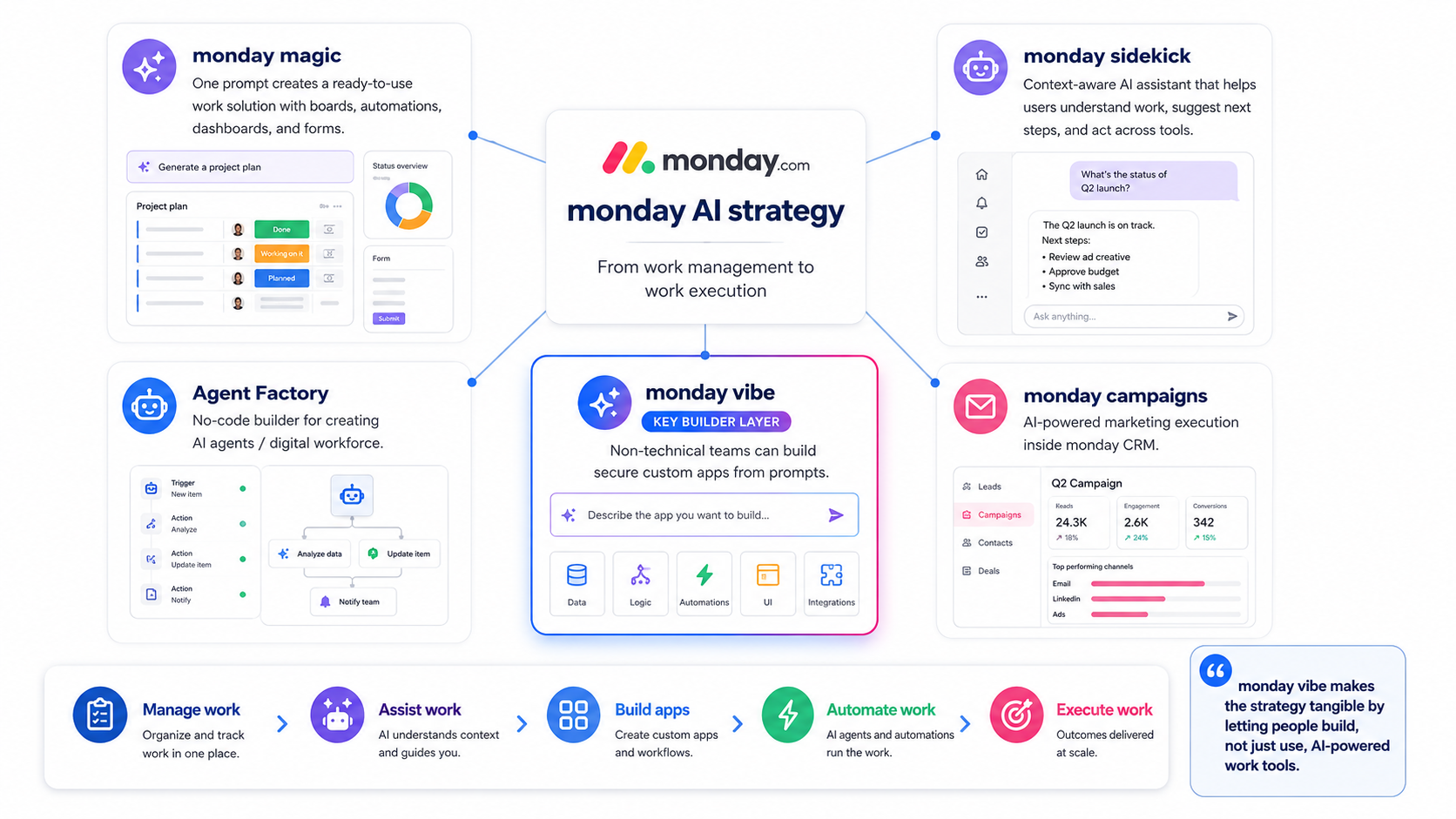
The strategic thread connecting all of these is the shift Monday’s CPTO Daniel Lereya has articulated directly: software that doesn’t just manage the work, but actually does it. Monday Vibe is the user-facing product that makes that shift most tangible, because it gives non-technical people the ability to build, not just use.
Frequently Asked Questions (FAQ)
Monday Vibe is an AI-powered no-code app builder inside Monday.com. You describe the application you want in plain language, and Vibe generates a fully functional, secure, enterprise-grade app – no coding required.
As of May 6, 2026, Monday Vibe bills on two credit rates. Building prompts sent to the AI during app creation average approximately 30 credits per message, varying by complexity and model. Runtime AI actions inside a published app (such as text generation or translation triggered by team members) consume 8 credits per AI call, plus 2 credits per integration trigger such as a Gmail or Outlook sync. Customers who purchase AI credits receive free live (published) Vibe apps based on their plan: Basic 1 app, Standard 2 apps, Pro 3 apps, and Enterprise 5 apps. Draft mode apps incur no publishing fee, but build prompts still draw from the credit pool. Customers on plans purchased before May 6, 2026, may be on different pricing. See the pricing section above or contact Monday.com support to confirm your model.
Building Vibe apps on any paid Monday.com plan consumes AI credits per prompt. Publishing apps is where the plan tier determines your free app allowance. Vibe is not available on the free plan. The cost kicks in when you publish apps, which draws from AI credits purchased alongside your plan. Under the May 6, 2026 pricing model, each paid plan tier includes a fixed number of free live (published) apps with an AI credits purchase. Vibe is not available on the free plan.
Dashboards, time trackers, HR onboarding portals, finance approval systems, vendor management tools, org charts, campaign performance trackers – any internal business tool your team needs.
No. Monday Magic generates boards and automations from prompts. Monday Vibe creates entirely new, standalone applications.
Yes. All apps are built on Monday.com’s enterprise-grade infrastructure with role-based access control, granular permissions, and automatic security governance. Apps are private by default.
Yes, for end users. Published Vibe apps are fully mobile-responsive, allowing team members to view dashboards, complete tasks, and interact with app content from any device. However, building and editing Vibe apps requires a desktop browser. The developer environment is not yet available on mobile or the Monday.com mobile app.
From prompt to working application in minutes. Iteration through conversation is instant.
Traditional no-code is drag-and-drop. Monday Vibe is conversational – you describe what you want, and AI builds it. The distinction matters because drag-and-drop still requires you to know how to structure the tool. With Vibe, you only need to know what you need.
The Bottom Line: Vibe Coding Is a Real Shift, Not a Feature
Monday Vibe is not a marketing headline dressed up as a product. The adoption numbers are real, the revenue milestone is verified, and the underlying concept – that describing software in plain language should be enough to build it – is one of the more consequential ideas in enterprise software right now.
For non-technical business professionals, this changes something fundamental about what’s possible. For IT and operations leaders, it raises a legitimate question about where the boundary between “citizen developer” and “developer” now sits. For Monday.com, it’s a deepening of the platform moat at exactly the moment when AI threatened to make platforms irrelevant.
The $187 billion low-code market projection from P&S Intelligence isn’t a distant forecast – it’s already underway. Vibe coding, and Monday Vibe specifically, is one of the more concrete early examples of what that market looks like in practice.
If your team is already on Monday.com and hasn’t explored Vibe yet, the free private app tier is the obvious starting point. Build something, test it, understand the constraints, then decide whether the credit-based publishing model makes sense for what you’ve built.
Ready to Build Your First Monday Vibe App?
As a Monday Official Partner, Camel Tech has helped 80+ businesses implement project management tools like Monday.com, Notion, and ClickUp. We don’t just configure tools – we build systems: workflows, automations, and training around how your business actually operates.
Book a free discovery call, and we’ll help you evaluate whether Monday Vibe fits your team and what a successful implementation looks like.
Read Related Articles
ServiceTitan is purpose-built for plumbing dispatch, GPS, and pricing. Monday.com is cheaper and flexible but
Should you migrate from Airtable after the Bending Spoons deal? Review the risks, compare alternatives,
Compare the best ClickUp consultants and agencies in 2026 by pricing, specialty, and red flags
Build a business that thrives without you
Unlock your ultimate life goals: Focus on high-leverage tasks, personal growth, and family time while pursuing your next big initiative.
Let's book a call with our expert.

Selected resource
Enter your email and we’ll send the resource directly to your inbox.
✓
Check your inbox
We’ve received your request and will send the resource to your email.
Please check your spam or promotions folder if you don’t see it shortly.